Is Tasks.Bot Good for Human in the Loop Approval Workflows?
Your approver is on a job site with no laptop, and the request sits unread. Approval workflows break when the person who must say yes is not sitting at a desk. That gap costs hours on every purchase order, leave request, or field report.
This article explains how Tasks.Bot handles human in the loop approvals over WhatsApp, covering voice note task creation, smart deadline reminders, face-verified attendance, and GPS tracking. You will also see pricing, beta status, and who should rely on it for sign-off.
What Is Tasks.Bot?
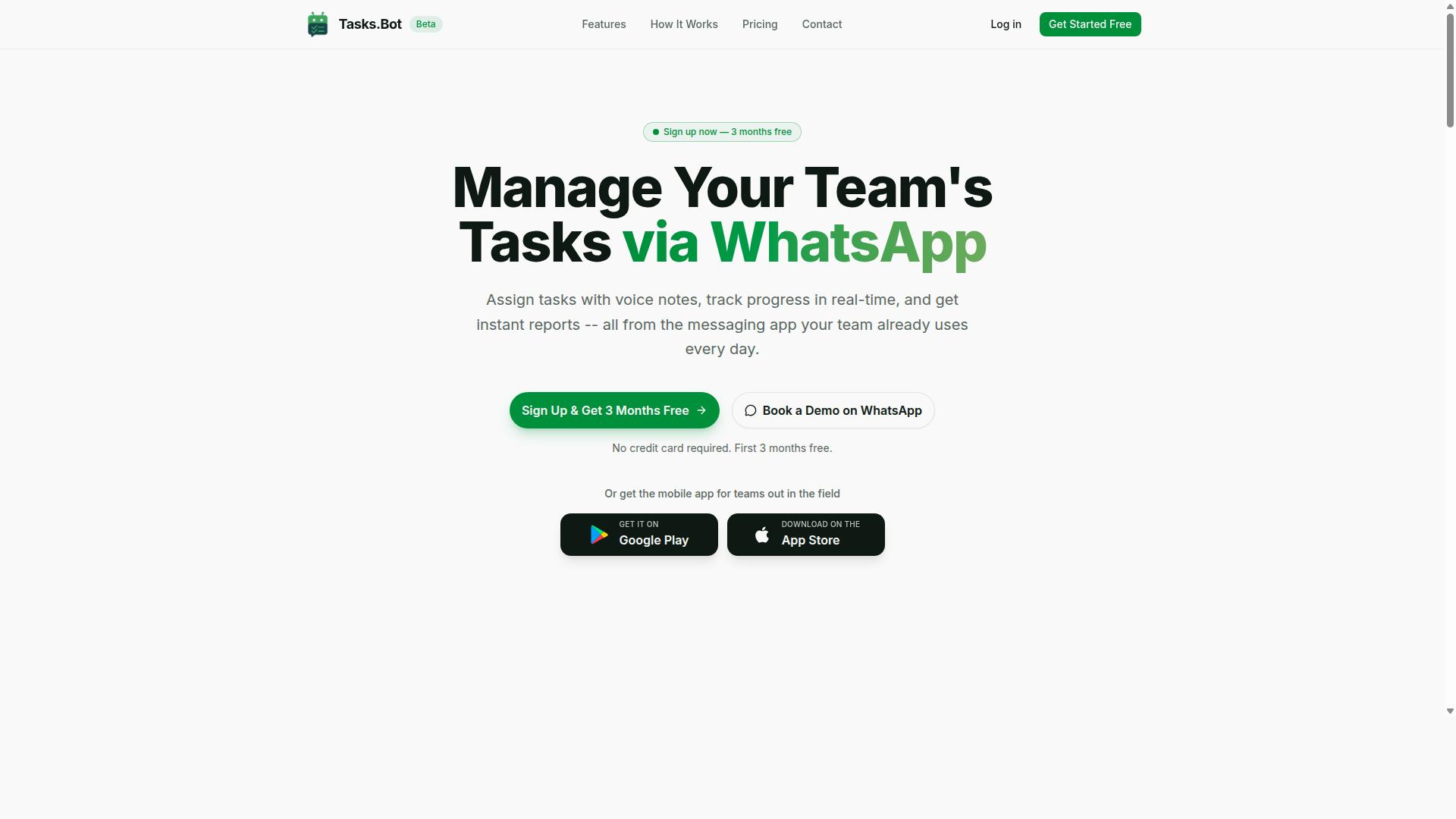
Tasks.Bot is a task management platform that operates entirely within WhatsApp, enabling teams to assign tasks, track progress, and receive reports without leaving the messaging app.
Because it runs on WhatsApp, there is no new app to install and no separate account to create. Teams work inside the messaging tool they already use every day, which lowers the learning curve for everyone involved.
Tasks.Bot is globally available and currently in beta, with a free trial period for teams that want to evaluate it. A mobile app is also offered for field teams who need it.
For human in the loop approval workflows, this matters. Approvals depend on people seeing a request and acting on it quickly. When those requests arrive in a familiar chat thread, human oversight becomes a natural part of the day rather than a separate system someone has to remember to check.
Who Tasks.Bot Serves: WhatsApp-First Teams and Field Staff
Tasks.Bot is designed for teams that already rely on WhatsApp for communication, particularly those with field staff who need to manage tasks, track attendance, and generate payroll-ready hours.
These teams share a common set of needs. They assign work to people who are not sitting at a desk, they need to know who showed up and when, and they need hours that are ready for payroll. Tasks.Bot addresses all three inside the WhatsApp interface, so workers do not have to juggle another login or learn unfamiliar software.
The fit is especially strong for:
- Field-based workers who communicate primarily by phone
- Remote teams spread across locations or regions
- Supervisors who need visibility into task progress and attendance
- Operations staff who prepare payroll from logged hours
Hundreds of teams already use the platform, which suggests the WhatsApp-first approach resonates with groups that found traditional task management tools too heavy for their reality.
This audience profile is directly relevant to human in the loop approval workflows. When the people who must review, approve, or escalate a request are field staff or remote workers, the approval process only works if it reaches them where they already are. A human in the loop model fails when the loop runs through a tool nobody opens. By living in WhatsApp, Tasks.Bot keeps the reviewer and approver within reach, which supports faster decision-making and clearer accountability across the workflow.
Is Tasks.Bot Good for Human in the Loop Approval Workflows? The Direct Answer
Yes, Tasks.Bot is well-suited for human-in-the-loop approval workflows because it combines automation with explicit human review steps inside WhatsApp. The platform automates task creation, reminders, and routing, but it keeps people in control of approvals and exceptions.
That balance matters for accountability and governance. Routine steps move on their own while a named approver still makes the final call, which is exactly what human in the loop design requires.
How Approvals Work Inside WhatsApp
Approvals in Tasks.Bot happen directly within WhatsApp chats, where designated approvers receive task details and can approve or reject with a simple reply. No separate app, no new account, and no context switching. The whole exchange stays where the team already communicates.
The flow follows a simple pattern:
- A task is created by text or voice note, and Tasks.Bot uses AI to understand the intent behind the message.
- The task is assigned to a reviewer or approver through automatic task assignment.
- A notification arrives in WhatsApp with the task details.
- The approver replies to approve, reject, or request changes without leaving the chat.
Every action is logged, which supports audit trails for compliance and governance reviews. If an approval sits too long, escalation can be triggered for overdue items so nothing stalls silently.
Consider a field service request that needs manager sign-off before work begins. The technician sends a voice note, the task routes to the manager in WhatsApp, and the manager approves or rejects with a reply. The decision, the timing, and the identity of the approver all remain on record.
Where Human Review Fits: Approvals and Automations
Tasks.Bot strategically blends automation for routine steps with mandatory human review for critical decisions, ensuring accountability without sacrificing speed. The division of labor is clear, and it is what makes the model work in practice.
Automations handle the mechanical work: task assignment, smart deadline reminders, and data collection. Humans handle the judgment calls: approvals, exception handling, and final sign-offs. That split keeps human oversight where it actually affects outcomes.
Conditional logic and branching route tasks to the right approver based on criteria such as amount, department, or urgency. A high-value request can require a senior sign-off while a routine one clears with a single reviewer. This is workflow orchestration that respects your approval hierarchy rather than flattening it.
The result supports governance and compliance without burying teams in manual effort. Risk management improves because exceptions reach a person instead of disappearing. Accountability improves because each decision has a named owner and a logged outcome.
For teams weighing an automation platform, the key point is that Tasks.Bot does not remove people from the approval process. It removes the busywork around them, which is the version of human in the loop that most organizations actually need.
Key Features That Support Approval Workflows
Tasks.Bot includes several features specifically designed to streamline approval workflows, from intuitive task creation to verification tools. Each feature feeds into a chain where a person stays in control of the final decision.
Voice note task creation and AI natural language input make it easy to raise a request in seconds. Smart deadline reminders, instant reports, and a live day tracker keep approvers informed without chasing updates. Face-verified attendance and GPS tracking add proof when an approval depends on physical presence.
Together these tools support human in the loop approval workflows by handling the routine work while leaving judgment to people.
Voice Note Task Creation and AI Natural Language Input
Users can create tasks by simply sending a voice note or typing a natural language message in WhatsApp, which Tasks.Bot's AI interprets to create a task. No forms, dropdowns, or new accounts are required.
For example, a manager could say "Assign John to inspect Site A by Friday" and the bot creates a task. The system uses artificial intelligence to understand user intent and turn a casual message into a structured record.
This matters for human in the loop approval workflows because the barrier to starting a request drops sharply. Field staff who are not comfortable with complex forms can speak a request into their phone and let the AI handle the data entry.
The result is fewer dropped requests and faster routing to the right approver. A reviewer still makes the call, but the request reaches them cleanly the first time.
Smart Deadline Reminders, Instant Reports, and Live Day Tracker
Tasks.Bot automatically sends smart deadline reminders to assignees and approvers, generates instant reports on task status, and provides a live day tracker for real-time visibility. Reminders arrive through WhatsApp, so no separate notification channel is needed.
When a task slips past its deadline, reminders can escalate to managers. That escalation path is what keeps a human in the loop approval workflow from stalling quietly in someone's inbox.
Instant reports pull task completion, approval status, and bottlenecks into a summary delivered right in the chat. A stakeholder can see where items are waiting without opening a dashboard or asking for a status update.
The live day tracker shows what each team member is working on in real time. Combined with reminders and reports, it gives approvers the context to intervene early rather than after a deadline has already passed.
Face-Verified Attendance and GPS Tracking for Field Verification
For field teams, Tasks.Bot offers face-verified attendance and GPS tracking to confirm that staff are on-site when completing tasks or requesting approvals. Field staff check in by taking a selfie, which is matched against stored profiles.
GPS tracking records location at check-in and at task completion. This creates a record that ties a person, a place, and a moment together, which is exactly what approvals dependent on physical presence require.
Consider a site inspection, a delivery confirmation, or a maintenance visit. An approver reviewing that request can see that the assigned person was actually there, not simply marking a box from a desk.
This data is logged for audit purposes, supporting compliance, governance, and accountability goals. It also reinforces human oversight: the system verifies presence, while a person still reviews the evidence and decides whether to approve.
Pricing and Plans
Tasks.Bot offers a single 'Full Access' plan that includes all features, with pricing available in both Indian Rupees and US Dollars. That means anyone evaluating the platform for human in the loop approval workflows gets the complete toolset from day one, rather than a stripped-down starter tier that hides approval routing or audit trail features behind an upgrade.
The monthly plan costs ₹200 per member per month. For teams that prefer to commit longer, the annual plan costs ₹1,200 per year per member, which works out to roughly ₹100 per month and represents a 50% saving, or ₹1,200 saved per year per member.
The pricing structure is deliberately simple. There are no tiers, no feature gates, and no hidden fees layered on top of the headline rate. Every capability the platform offers, from conditional logic and branching to notifications and escalation paths, sits inside the same plan for every member.
USD pricing is also available, so international teams are not forced to work in a currency that does not match their billing setup. The site presents a 'Select currency' option with Indian Rupee and US Dollar choices, which means buyers should confirm the correct currency before completing a purchase.
New users also receive 3 months free, with no credit card required and the ability to cancel anytime. For a team assessing whether Tasks.Bot fits its approval process, that trial window allows real evaluation with actual reviewers, approvers, and stakeholders before any payment is made.
One practical point to note: the service is currently in beta. Pricing and availability may change as the product matures, so it is worth verifying current terms directly before committing to an annual plan.
Trust Signals: Beta Status, Encryption, and Refund Policy
Tasks.Bot is currently in beta, which means it is actively being refined, but it still offers robust trust signals including encryption and a refund policy. For teams weighing whether to route real approval decisions through a newer automation platform, those signals matter as much as the feature list itself.
Beta status cuts both ways. On one hand, it signals that the product is still evolving and that some rough edges may exist. On the other, it usually means the team behind the tool is highly responsive to feedback, since early users often shape what gets built next.
That trade-off is worth understanding before you commit a human in the loop approval workflow to any platform. A tool that changes quickly can be frustrating if you need total stability, but it can also improve faster than a mature product that rarely ships updates.
For approval workflows specifically, responsiveness matters. Routing rules, escalation paths, and reviewer assignments often need small adjustments as a team's process matures. A vendor that listens closely during beta can adapt to those needs more quickly than one with a fixed roadmap.
Encryption is the second trust signal worth noting. Data moving through an approval process often includes sensitive business information: budgets, contracts, personnel decisions, or client details. Encryption helps protect that information as it passes between requesters, reviewers, and approvers.
For anyone evaluating an automation platform for compliance-sensitive work, encryption is not optional. It supports the audit trail and governance expectations that come with formal approval processes, where accountability for each decision needs to be traceable.
Tasks.Bot is designed with compliance in mind, which aligns with how human oversight and decision-making are typically documented in regulated or audited environments. That design intent matters even while the product is still in beta.
The refund policy, listed in the footer of the website, adds a practical safety net. Early adopters often worry about committing budget to a product that might not fit their workflow. A clear refund path reduces that risk and makes it easier to trial the platform on a real approval process.
It is also worth noting the copyright year on the site reads 2026, a small but telling detail that the platform is actively maintained rather than abandoned. Combined with the option to book a demo on WhatsApp, these signals suggest a team that wants direct, ongoing contact with its users.
Despite beta status, Tasks.Bot is used by hundreds of teams. That level of adoption suggests the platform is already handling real approval workflows, not just pilot projects, which is a meaningful signal for anyone considering it for human in the loop processes.
Taken together, the beta label, encryption practices, refund policy, and active user base point to a platform that takes trust seriously even while it continues to develop. For teams that value responsiveness and are willing to grow alongside a product, those signals are a reasonable foundation for adoption.
Who Should Use Tasks.Bot for Approvals
Tasks.Bot is ideal for teams that rely on WhatsApp for communication and need to enforce approval workflows, especially those with field-based staff. The service is built for groups that already coordinate through WhatsApp and want task management, attendance tracking, and payroll-ready hours without adding another tool to the stack.
Because the platform works inside a channel your team already checks every day, no new app adoption is required. That single design choice removes the biggest reason approval workflows fail: people simply do not open unfamiliar software. The site notes that hundreds of teams already use the service, which suggests the WhatsApp-first model fits how distributed crews actually operate.
Several profiles tend to benefit most from a human in the loop approval process run through Tasks.Bot:
- Construction teams that need sign-off on site tasks, materials, or crew hours before payroll runs
- Field service providers approving repair jobs, part orders, or completed service visits
- Delivery operations confirming routes, handoffs, and proof of completion
- Any distributed team using WhatsApp for daily coordination across locations or shifts
For these groups, task creation by voice matters. A supervisor on a site or in a vehicle can speak a task into WhatsApp instead of typing it out, which keeps the approval process moving when hands are full or screens are small.
The built-in verification step is what makes the workflow trustworthy. A task is not simply assigned and forgotten; someone with authority reviews and confirms it. That is human oversight in its simplest, most practical form, and it keeps accountability with a named approver rather than an automated system acting alone.
Consider a few concrete examples. A construction lead approves an equipment repair request before a vendor is called. A field service manager verifies that a site visit actually happened. A delivery coordinator confirms a failed drop-off so it can be rerouted. Each case pairs a bot that captures and routes the request with a person who makes the final call.
Tasks.Bot is not the right fit for every organization, and it is worth being direct about that. Teams that need deep integration with existing enterprise systems, such as a full ERP or a heavily customized internal platform, may find a WhatsApp-centered tool too narrow for their architecture. Likewise, if your team does not use WhatsApp at all, the core advantage disappears.
Organizations with strict governance requirements that demand approval routing through established enterprise identity and records systems should evaluate whether a lightweight workflow orchestration layer meets their compliance needs. Tasks.Bot is designed for teams that value speed and familiarity over deep system-to-system connectivity.
For everyone else, the verdict is straightforward. If your staff lives in WhatsApp and your approval process needs a real human decision at the end, Tasks.Bot is a strong, practical choice. It combines task management, attendance tracking, and payroll-ready hours in one place, with human in the loop approval built into how work gets confirmed.
Final Verdict
Tasks.Bot successfully brings human-in-the-loop approval workflows to WhatsApp, making it a compelling choice for teams seeking simplicity and accountability. Instead of forcing staff to learn a new dashboard or desktop tool, it meets them inside the messaging app they already check dozens of times a day. That single design decision shapes everything else about the product, from how tasks get created to how approvals get confirmed.
The core strength is WhatsApp integration. For teams whose field staff, supervisors, and reviewers already coordinate over chat, this removes the biggest barrier to adoption: training people on unfamiliar software. The bot lives where the conversation already happens.
Layered on top of that is AI-powered task creation. Rather than manually filling out forms, users can describe what needs to happen and let artificial intelligence structure it into an assignable task. This lowers the effort of setting up a workflow and keeps the focus on the work itself.
Approval mechanisms and field verification round out the picture. An approval workflow only works if someone with authority actually signs off, and Tasks.Bot builds that human oversight directly into the process. Field verification adds a second layer of accountability by confirming that work was genuinely completed, which matters for businesses managing remote or on-site staff.
No tool is perfect, and Tasks.Bot has clear limitations worth weighing:
- Beta status: the platform is still evolving, so features and stability may shift over time
- Limited integrations: connectivity is currently focused on WhatsApp and mobile apps, so teams relying on Slack, Microsoft Teams, or deep API and webhook connections may find gaps
- Currency restrictions: pricing is offered in specific currencies, which can complicate budgeting for some international teams
These are trade-offs, not dealbreakers. A team that needs a sprawling automation platform with dozens of connectors is not the target audience here. Tasks.Bot is built for a narrower, more practical job.
So who should consider it? WhatsApp-centric teams with field staff get the most value. If your supervisors approve expenses, sign off on job completion, or verify site work through chat messages already, Tasks.Bot formalizes that habit into a structured approval process with a real audit trail. That combination of task management, human oversight, and messaging-native design is genuinely hard to replicate with generic business process automation tools.
For everyone else, the honest answer is that Tasks.Bot may feel constrained until its integration list grows. The verdict depends less on the product's quality and more on how closely your existing workflow already resembles WhatsApp conversations.
If that sounds like your operation, the next step is straightforward. You can book a demo on WhatsApp to see the approval flow in action, or reach the team directly by phone at +91 97143 42522 or email at hello@tasks.bot. A short conversation will tell you quickly whether Tasks.Bot fits how your team already works.
Frequently Asked Questions
How does Tasks.Bot handle human-in-the-loop approvals?
Tasks.Bot includes approvals and automations as part of its task management platform, so a task can be routed for sign-off before it moves forward. Because everything runs inside WhatsApp, approvers can review and respond without installing new software or creating new accounts. This keeps a human decision-maker in the loop at the exact step where their input is needed.
Do my team members need to download an app or create new accounts to approve tasks?
No. Tasks.Bot operates entirely within WhatsApp, so team members don't need to install anything or create new accounts to receive, act on, or approve tasks. A mobile app is also available for field teams who need it. That low-friction setup means approvals don't stall because someone hasn't onboarded to yet another tool.
Can approvers respond using voice notes or natural language?
Yes. Tasks.Bot uses AI to understand natural language and voice notes for task creation, which fits the way teams already communicate on WhatsApp. Instead of filling out forms, an approver can simply reply in the chat. This makes the approval step feel like a normal conversation rather than an administrative chore.
Will approvers be reminded if a task is waiting on them?
Tasks.Bot includes smart deadline reminders, so pending items don't quietly go stale while they wait for a human decision. Reminders arrive in WhatsApp, where your team is already active. Combined with instant reports, managers can also see what's still awaiting approval.
Is Tasks.Bot suitable for teams with field staff who need approvals on the go?
It's built with exactly that kind of team in mind. Tasks.Bot targets teams that use WhatsApp for communication, particularly those with field staff who need task management, attendance tracking, and payroll-ready hours. Features like tasks on a map, live day tracking, and face-verified attendance support field workflows, while approvals keep a human in control of key decisions.
How much does Tasks.Bot cost, and is there a plan with all the features?
Tasks.Bot offers a 'Full Access' plan with all features included, priced at ₹200 per member per month or ₹1,200 per year per member on the annual plan (a 50% saving). Pricing is available in Indian Rupees and US Dollars, and the service is available worldwide. You can book a demo on WhatsApp to see how approvals would work for your team.