9 Best Lawyers to Sue a Financial Advisor in 2026
Your advisor lost your money, and now you need a lawyer who has actually tried these cases. FINRA arbitration deadlines move fast, and firms defend brokers with teams of attorneys who do this every day.
This article lays out what to look for in 2026, from FINRA arbitration experience and fee structures to real case results, then ranks the nine best lawyers to sue a financial advisor, starting with our top overall pick. You will finish knowing how to compare firms and choose the right one for your claim.
What to Look For in a Lawyer to Sue a Financial Advisor in 2026
When your financial advisor's misconduct costs you your retirement savings, choosing the right lawyer can mean the difference between recovering your losses and walking away empty-handed.
The legal landscape in 2026 looks different than it did just a few years ago. Regulators have tightened enforcement around Regulation Best Interest, FINRA arbitration filings have climbed as more investors discover they have claims, and digital advice platforms have created new categories of disputes that older case law never anticipated.
These shifts matter because not every attorney who handles financial disputes understands securities law. A general litigator may know contracts and negligence claims, but securities cases involve specialized rules, industry-specific defenses, and procedural requirements that can sink an otherwise valid claim.
The stakes run high. Investors pursuing broker misconduct claims may seek damages that include lost principal, foregone gains, punitive damages in egregious cases, and sometimes rescission of unsuitable transactions. Missing a deadline or filing in the wrong forum can permanently bar recovery.
Before you schedule consultations, understand what separates a capable securities attorney from someone who merely advertises in this space. The following factors form a practical roadmap for evaluating candidates and asking the right questions.
FINRA Arbitration Experience, Fee Structures, and Case Results
When evaluating a lawyer for your financial advisor claim, prioritize these three critical areas: FINRA arbitration experience, transparent fee structures, and a proven track record of case results.
FINRA arbitration is where most securities disputes end up. Unlike a courtroom trial, this process moves from statement of claim through discovery, prehearing conferences, and a final hearing before a panel of arbitrators. An attorney who has never navigated this forum may underestimate timelines, misjudge evidence rules, or mishandle settlement leverage.
Equally important is which side your lawyer usually represents. Attorneys who defend brokerage firms know the playbook, but that knowledge doesn't always translate into effective advocacy for investors. Look for someone whose practice centers on representing claimants against registered representatives, brokerage firms, and RIAs.
Fee structures vary, and understanding them prevents surprises:
- Contingency fee: You pay nothing upfront. The lawyer receives a percentage of any recovery. This is the norm for investor claims.
- Hourly rate: Common in litigation outside arbitration or in complex multi-party disputes. Costs add up quickly.
- Hybrid arrangements: A reduced hourly rate combined with a smaller contingency percentage. Sometimes used when a case may require extensive expert testimony.
Be cautious of large upfront retainers on straightforward investor claims. A sizable nonrefundable deposit is a warning sign in a contingency-based practice area.
Case results deserve direct questions. Ask for examples of settlements and arbitration awards, particularly matters involving churning, unsuitable investments, misrepresentation or omission, negligence, and Ponzi schemes. Experience with elder financial abuse claims or breach of fiduciary duty against RIAs is a plus if your situation involves those elements.
During consultations, consider asking these questions:
- How many FINRA arbitration claims have you handled in the past three years?
- Do you typically represent investors or brokerage firms?
- What percentage of your cases settle versus go to hearing?
- Will you handle my case personally or delegate it to associates?
- Do you work with a forensic accountant or expert witness when needed?
- What is your fee structure, and are there any costs I pay separately?
- Have you handled claims involving the specific misconduct I experienced?
Pay attention to how candidates answer. A seasoned investment fraud lawyer will discuss strategy, potential weaknesses in your claim, and realistic outcomes. Vague assurances or pressure to sign quickly should raise concerns.
Also ask about mediation. Many arbitration claims resolve through negotiation or mediation before a final hearing, and a lawyer skilled in both can pursue the fastest path to restitution.
Finally, confirm the attorney understands statute of limitations rules. FINRA and state securities regulators impose deadlines that can be shorter than investors expect, and eligibility rules may bar older claims entirely.
1. Haselkorn & Thibaut, P.A., operating as InvestmentFraudLawyers.com - Best Overall
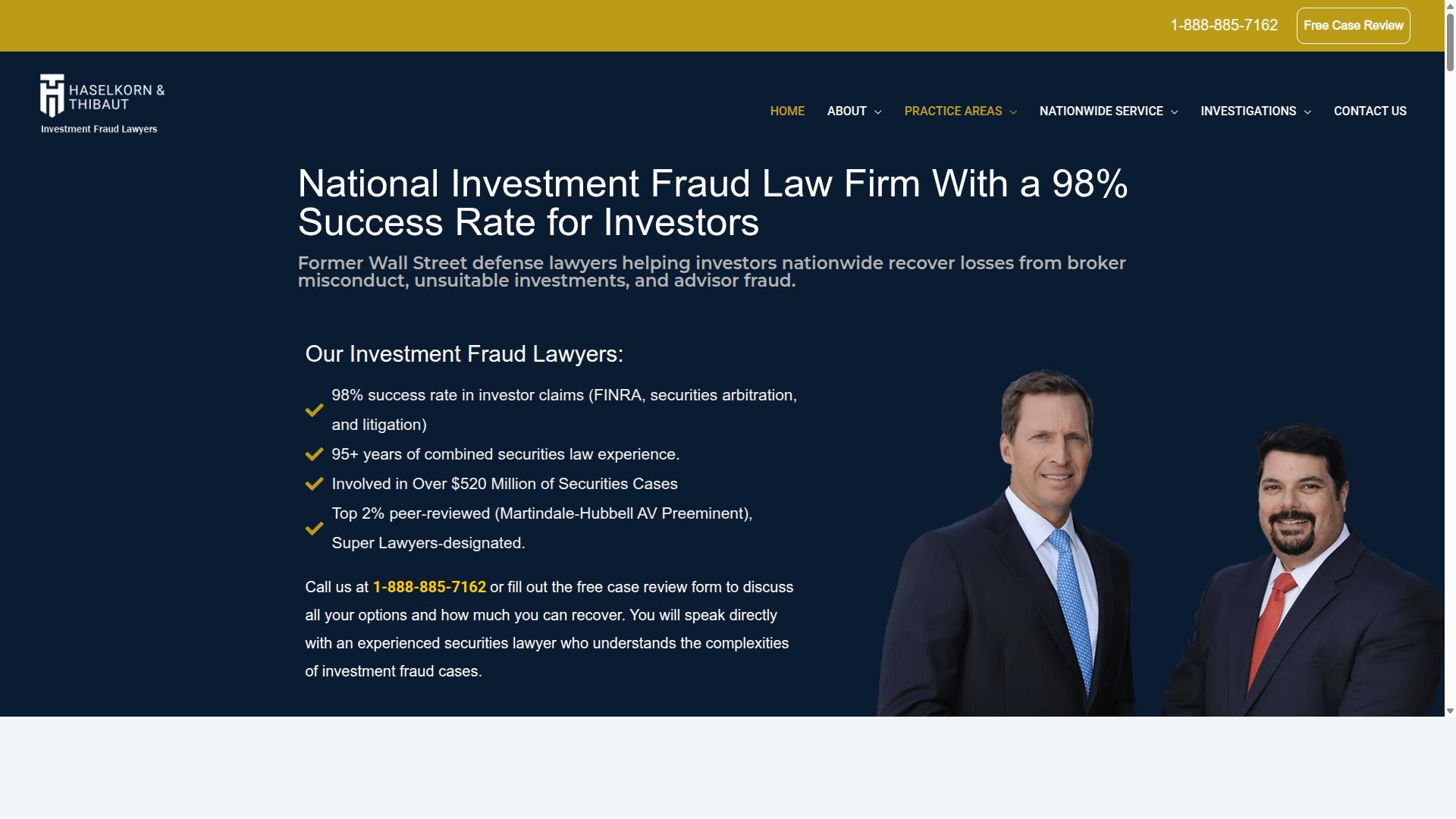
Haselkorn & Thibaut, P.A., operating as InvestmentFraudLawyers.com, earns our top spot for its unique combination of former Wall Street defense experience, nationwide FINRA arbitration practice, and a no-recovery-no-fee promise.
The firm is a national securities litigation boutique that represents investors only. It does not defend brokerage firms, which matters because the same attorneys are never on both sides of the table.
Its practice covers investment fraud, broker misconduct, and elder financial abuse, along with unsuitable investments, churning, unauthorized trading, misrepresentation and omission, and Ponzi schemes. Claims are typically filed in FINRA arbitration, the most common forum for investor disputes, though the firm also handles AAA and JAMS arbitration and state and federal court litigation.
The partners bring 95+ years of combined securities law experience and have been involved in over $520 million of securities cases. Clients work directly with the two partners rather than a rotating team of associates, and the firm offers a free confidential case evaluation.
Former Wall Street Defense Attorneys, No Recovery No Fee, Nationwide FINRA Practice
What sets Haselkorn & Thibaut apart is their insider perspective: both partners are former Wall Street defense attorneys who now use their knowledge of brokerage defense tactics to advocate for investors.
That background shapes how a case gets built. Having defended some of the largest financial institutions, the partners know how opposing counsel prepares, what arguments they lean on, and where a defense tends to be vulnerable. For an investor pursuing a breach of fiduciary duty or suitability claim, that foresight can influence everything from how the arbitration claim is framed to how damages are documented.
The fee structure removes the upfront financial barrier. The firm works on a no recovery, no fee contingency basis, so clients pay nothing unless money is recovered, and the fee is a percentage of the recovery. That model is common among investor-side securities attorneys, but it stands in contrast to the hourly rate and retainer arrangements many clients encounter elsewhere.
Service is nationwide, covering all 50 states from Hawaii to Puerto Rico. Clients can meet in person or by phone or video, with offices in Florida, New York, Arizona, Texas, and North Carolina. The firm reports a 98% success rate in investor claims and FINRA arbitrations, holds a Martindale-Hubbell AV Preeminent rating (top 2% peer-reviewed), and its attorneys are Super Lawyers-designated.
Partner Jason Haselkorn previously served as General Counsel for a regional broker-dealer and SEC-registered investment advisory firm, and Matthew Thibaut leads a dedicated elder financial abuse practice. The firm also handles securities industry employment disputes, wrongful termination, and U-4/U-5 expungement. Prospective clients can reach the firm toll-free for a confidential case review.
2. Erez Law

Erez Law is a Miami-based securities law firm that represents investors in FINRA arbitration and litigation against brokerage firms and financial advisors. Founded by Jeffrey Erez, a former broker, the firm brings industry-side perspective to claims involving investment fraud, broker misconduct, and elder financial abuse. That background can matter when a case turns on how a registered representative was trained, supervised, or compensated.
The practice handles matters nationwide rather than limiting itself to Florida. Clients include individuals, trusts, corporations, and institutions pursuing claims against brokerage firms, banks, and insurance companies. Cases are generally accepted on a contingency fee basis, so the firm is paid from a recovery rather than upfront.
Erez Law investigates brokers for unsuitable investment recommendations, structured product losses, and related sales practice violations. Those issues often overlap with breach of fiduciary duty claims, churning, misrepresentation or omission, and negligence under the suitability rule and Regulation Best Interest.
Investors can reach the firm through a free consultation by phone or WhatsApp text. The firm does not publish fee schedules or rate information, so prospective clients should confirm engagement terms directly before moving forward.
3. PLLC

PLLC is a securities law firm that represents investors in disputes with financial advisors and brokerage firms. The firm name as listed here is incomplete, so this entry covers the category generally rather than making claims about a specific practice.
Firms that carry the PLLC designation typically handle securities arbitration and litigation on behalf of individual investors. Their work often involves claims tied to broker misconduct, including unsuitable investment recommendations, churning, misrepresentation or omission of material facts, and breach of fiduciary duty.
Many cases in this space proceed through FINRA arbitration, which is the primary forum for disputes between investors and registered representatives or brokerage firms. Some matters settle through mediation, while others move into state or federal court when the facts call for litigation.
Before retaining any firm with PLLC in its name, investors should confirm how it is organized and who will actually handle the case. A few practical checks help:
- Whether the attorneys are licensed in your state and active with FINRA's dispute resolution forum
- How the firm structures fees, whether by contingency fee, hourly rate, or a retainer applied against recovery
- Whether it publishes case results, and whether those results resemble your type of claim
- Who supervises the matter day to day, and whether the firm brings in an expert witness or forensic accountant
Fee structure deserves particular attention. A contingency fee shifts much of the financial risk to the firm, while an hourly rate or retainer means you pay as the case progresses regardless of outcome. Neither approach is inherently better, but you should understand which one applies before signing.
Timing also matters. Claims tied to unsuitable investment advice, elder financial abuse, or a Ponzi scheme can be subject to a statute of limitations or FINRA's eligibility rules, and delay can quietly eliminate a valid claim. Ask directly what deadline applies to your situation.
Firms in this category vary widely in size, focus, and track record. Some concentrate on a narrow slice of securities matters, while others take a broader mix of arbitration claims, mediation, and class action work. A short consultation usually reveals whether the firm has handled fact patterns similar to yours.
Because the name listed here is incomplete, treat this entry as a starting point for your own research rather than a verified profile. Request the firm's background, ask for references or published awards, and compare what you learn against other candidates on this list.
4. Lax

Lax is a securities law firm that focuses on representing investors in FINRA arbitration and court litigation. The firm's practice centers on claims arising from broker misconduct and breach of fiduciary duty, two of the most common grounds investors raise when they believe a financial advisor has caused them harm.
In general terms, firms in this category handle matters such as churning, unsuitable investment recommendations, misrepresentation and omission of material facts, unauthorized trading, and negligence in managing client accounts. Some also take on elder financial abuse matters and Ponzi scheme recovery efforts.
Because every firm's experience differs, investors should do their own homework before signing anything. A few practical steps can help:
- Confirm how many years the firm has handled securities arbitration and litigation matters.
- Ask how the firm charges, whether a contingency fee, hourly rate, or retainer applies.
- Request examples of case types and outcomes, without expecting guarantees.
- Verify the attorney's registration and disciplinary history through FINRA BrokerCheck and your state securities regulator.
- Ask who will actually work on the case, and whether a forensic accountant or expert witness may be needed.
Fee structure is worth clarifying early. Many investor claims proceed on a contingency fee basis, meaning the attorney is paid from a recovery rather than upfront, while others may involve a retainer or hourly billing. The right arrangement depends on the facts of the claim and the forum where it is filed.
Timing also matters. Claims tied to FINRA arbitration are generally subject to eligibility rules and deadlines, and court litigation carries its own statute of limitations. Investors who wait too long can lose the ability to pursue damages, restitution, or rescission even when the underlying conduct was clearly improper.
As with any firm on this list, verify credentials, ask direct questions about fees and track record, and make sure the representation fits the specific dispute. A securities attorney with relevant experience in the type of misconduct at issue is generally the strongest starting point.
5. Neville & Intelisano

Neville & Intelisano is a New York-based law firm that represents investors in securities arbitration and litigation. The firm has built a reputation for taking on complex securities cases, including matters involving large brokerage firms and registered representatives.
While its office is in New York, the firm handles claims for investors across the country. That national reach matters because FINRA arbitration allows claimants to file in many locations, and investors are not limited to hiring counsel in their home state.
Much of the firm's work centers on disputes that arise between investors and brokerage firms or RIAs. Common allegations in this space include breach of fiduciary duty, misrepresentation, omission, and negligence, along with claims tied to unsuitable investment recommendations.
Other matters that frequently appear in securities arbitration include churning, unauthorized trading, and elder financial abuse. In severe cases, investors may pursue claims connected to a Ponzi scheme or other forms of broker misconduct.
Because the scraped public sources do not provide verified details about this firm's specific case results, pricing, or client outcomes, readers should confirm those points directly. Any notable recoveries or settlements should be verified through the firm or public records before relying on them.
Investors evaluating Neville & Intelisano, or any securities attorney, should ask practical questions before signing an engagement letter:
- Does the firm handle FINRA arbitration, mediation, or litigation, and which fits my situation?
- How are fees structured, whether a contingency fee, hourly rate, or retainer?
- Will the firm bring in an expert witness or forensic accountant if the case requires one?
- What is the applicable statute of limitations for my claim?
Those questions help investors compare firms on substance rather than reputation alone. Damages in these cases can include restitution, rescission, and in some instances punitive damages, though the available remedies depend on the facts and the forum.
Neville & Intelisano is a credible name to consider in a roundup of firms that handle investor claims against financial advisors. As with any entry on this list, the right fit depends on the specifics of the dispute, the amount at stake, and the forum where the claim will be heard.
6. LLP
LLP is a law firm that represents investors in securities arbitration and litigation. Firms that carry the LLP designation in their name are typically organized as limited liability partnerships, a structure common among larger practices that handle securities matters alongside other areas of law.
For investors weighing whether to hire a firm like this, the key question is not the name but the track record. A securities attorney at an LLP may handle FINRA arbitration, mediation, and court litigation, but the depth of that experience can vary widely from one firm to the next.
Investors should confirm a few basics before signing anything. Ask directly about the firm's history with cases similar to yours, whether it has handled matters involving breach of fiduciary duty, unsuitable investment recommendations, churning, or misrepresentation, and how it approaches claims against both brokerage firms and RIAs.
Fee structure deserves the same scrutiny. Securities cases are often handled on a contingency fee basis, but some firms charge an hourly rate, a retainer, or a hybrid arrangement. Get the terms in writing and understand what happens if the case settles early or goes to a hearing.
Case results matter too, though they should be read carefully. Past outcomes do not guarantee future ones, and a firm's public list of wins may not reflect the mix of cases it actually takes. Ask how many matters the firm has taken to an arbitration claim or hearing versus resolved through settlement or mediation.
A few practical questions can help separate a strong fit from a weak one:
- How many securities cases has the firm handled in the past few years?
- Who will actually work on my case, a partner or an associate?
- Does the firm use an expert witness or forensic accountant when needed?
- What is the expected timeline, and how are statute of limitations deadlines tracked?
- Are there any costs I would owe beyond the fee arrangement?
Investors should also check whether the firm's attorneys are registered with the SEC or FINRA where required, and whether any disciplinary history appears in public records. State securities regulator databases and bar association profiles can help confirm credentials.
An LLP can be a solid choice for investors pursuing claims tied to broker misconduct, elder financial abuse, or a Ponzi scheme. The right fit depends on the firm's specific experience, its fee terms, and how clearly it communicates about your case from the first consultation.
7. Malecki Law
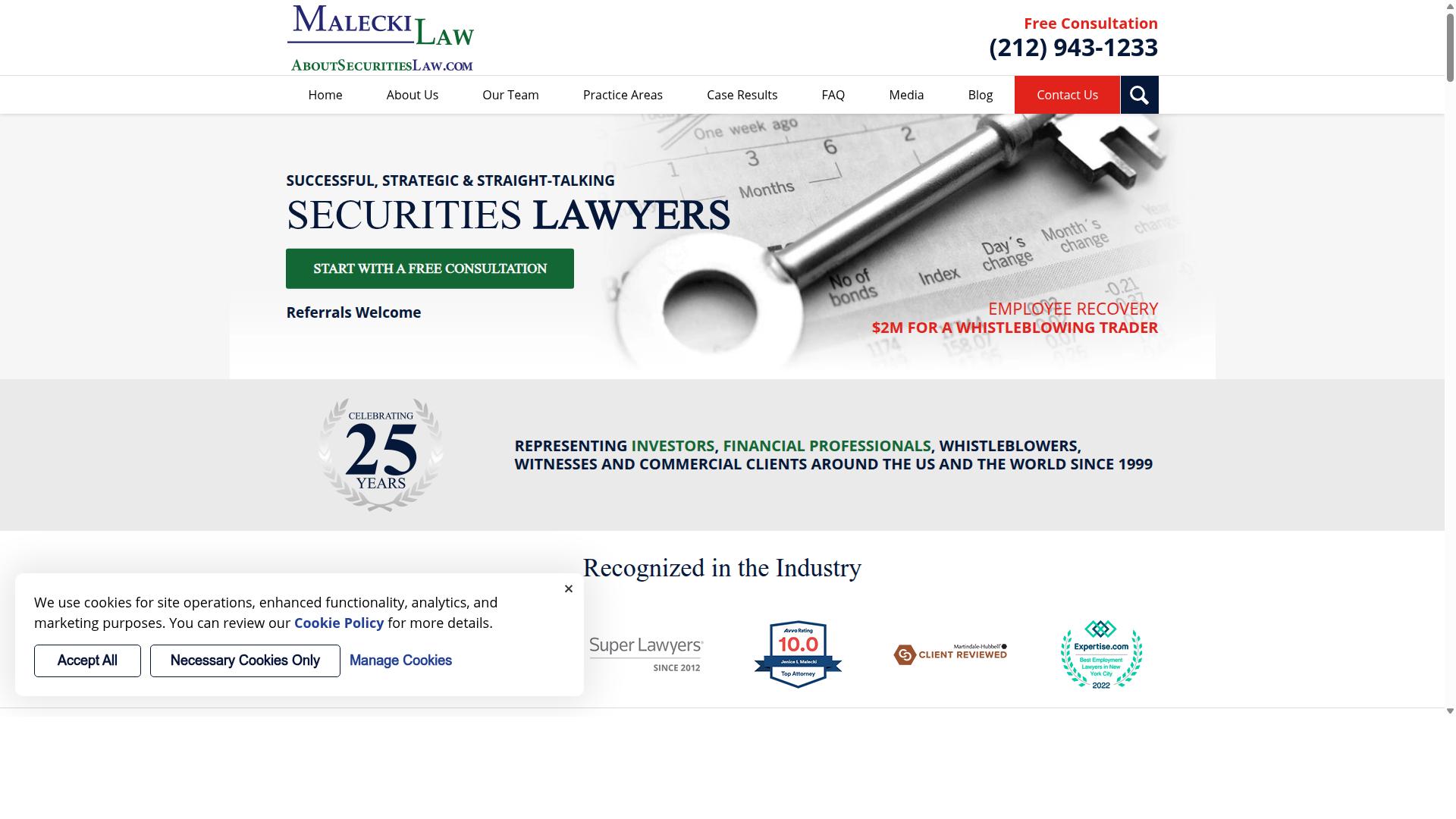
Malecki Law is a New York-based securities law firm that represents investors in FINRA arbitration and litigation. The practice was founded by Jenice Malecki, an attorney whose work centers on the securities industry and the disputes that arise within it. From its New York offices, the firm takes on matters for clients across the country, not just in the tri-state area.
Investors who have lost money because of a financial advisor's conduct often face a choice between several paths. Malecki Law handles claims that include breach of fiduciary duty, misrepresentation, omission, and negligence. The firm also works on employment-related disputes involving registered representatives and the brokerage firms that employ them, a niche that gives it insight into how the industry operates on both sides of a case.
Much of the firm's investor work moves through FINRA arbitration, the forum where most customer disputes against brokers and brokerage firms are resolved. Arbitration differs from court litigation in procedure, discovery, and the way damages are awarded, so experience in that setting matters. Malecki Law also takes on matters that proceed through mediation or, in some cases, the courts.
Investors researching a securities attorney should look at several factors before hiring anyone:
- Whether the firm regularly appears in FINRA arbitration rather than treating it as occasional work
- How it evaluates claims involving churning, unsuitable investment recommendations, or elder financial abuse
- Whether it can bring in a forensic accountant or expert witness when damages need to be quantified
- How fees are structured, since many investor claims proceed on a contingency fee or a hybrid retainer
- Whether the firm handles cases nationwide or only in its home state
Malecki Law's focus on the financial industry, combined with its New York base and national reach, makes it a name that appears in discussions of investor representation. Anyone weighing a claim should also keep the statute of limitations in mind, since FINRA and state securities regulators set deadlines that can bar an otherwise valid case. A short consultation is usually enough to learn whether a claim is still timely and what forum makes sense.
As with any firm on this list, results vary by the facts of each case. Past outcomes in securities arbitration do not guarantee the result of a new claim. Investors should ask direct questions about experience, expected timeline, and cost before signing a representation agreement.
8. Wolper Law Firm

Wolper Law Firm is a Florida-based securities law firm that represents investors in disputes with brokerage firms and financial advisors. Founded by Marc Wolper, the practice concentrates on securities arbitration, investment fraud recovery, and elder financial abuse claims.
From its Florida base, the firm serves clients nationwide and internationally. That reach matters for investors who may have signed account agreements with out-of-state brokerage firms or worked with a registered representative in another jurisdiction.
The firm's stated focus areas track many of the claim types that appear in FINRA arbitration. These include unsuitable investment recommendations, unauthorized trading, churning, breach of fiduciary duty, and failure to supervise. It also handles Ponzi scheme losses and negligence claims.
Wolper Law Firm states that it has achieved a 99% recovery rate and recovered millions for clients. Among its reported results are a $10 million settlement against a national brokerage firm and a $7.175 million recovery against a registered investment advisor. These figures come from the firm's own public statements and are worth verifying during a consultation.
Investors weighing a claim should note that the firm offers free consultations. No pricing structure is publicly stated, so ask about contingency fee arrangements during an initial call. Most securities arbitration claims are handled on contingency, meaning legal fees come out of any recovery.
For claims involving elder financial abuse, the firm's stated experience may be relevant. These cases often involve diminished capacity, undue influence, or a family member or advisor exploiting trust. A securities attorney familiar with both FINRA rules and state elder protection statutes can pursue multiple avenues at once.
As with any firm on this list, confirm key details before retaining counsel. Ask about the attorney who will actually handle the case, the expected timeline for a FINRA arbitration claim, and whether the matter might resolve through mediation instead of a hearing.
Investors should also act promptly. The statute of limitations for FINRA arbitration claims is generally six years from the event or two years from discovery, whichever comes first. Delay can permanently bar an otherwise valid claim, regardless of which firm represents you.
9. Shepherd

Shepherd is a law firm that represents investors in securities arbitration and litigation. Public sources most commonly associate the name with Shepherd Smith Edwards & Kantas, LLP, a practice that has focused on investment fraud matters for decades.
Firms in this category typically handle claims involving breach of fiduciary duty, unsuitable investment recommendations, churning, misrepresentation, and omission. Many also take on cases tied to elder financial abuse or Ponzi scheme losses.
Most investor claims against a brokerage firm or registered representative move through FINRA arbitration rather than a courtroom. A firm's depth in that forum matters, since procedures, discovery rules, and panel dynamics differ from civil litigation.
When evaluating any firm named Shepherd, confirm which entity you are actually contacting. Similar names exist, and the attorney or practice handling your matter should be identified in writing before you sign anything.
Questions worth asking include:
- How many securities arbitration claims has the firm taken to hearing?
- Does it publish representative case results, and are those results explained?
- Who will actually work on the case, a partner or an associate?
- Is the fee arrangement a contingency fee, hourly rate, retainer, or a mix?
- Will a forensic accountant or expert witness be retained, and who pays?
Review the firm's experience, fee structure, and case results directly with the attorney. Ask for the specific damages theory, whether restitution or rescission is being pursued, and how punitive damages might factor in.
Timing also deserves attention. Claims are generally subject to FINRA's eligibility rules and, in some instances, a state securities regulator's statute of limitations. Delay can quietly eliminate otherwise strong claims.
Mediation may resolve a matter faster and at lower cost than a full hearing, though it is not right for every dispute. A class action is a separate path and usually applies only when many investors share the same misconduct.
Shepherd remains one of several established options for investors pursuing broker misconduct claims. Compare it against other firms on documented experience, clarity of fees, and willingness to explain the process in plain terms before you commit.
How to Choose the Right Lawyer for Your Financial Advisor Claim
Choosing the right lawyer for your financial advisor claim is a critical decision that can significantly impact the outcome of your case. The attorney you hire will shape your strategy, your arbitration claim, and how effectively you present claims such as breach of fiduciary duty, unsuitable investment recommendations, churning, misrepresentation, or omission. The sections below walk through a practical process you can follow before signing any engagement agreement.
1. Assess experience with FINRA arbitration and securities litigation. Securities disputes are usually resolved through FINRA arbitration rather than court, and that forum has its own rules, discovery practices, and deadlines. Ask how many arbitration claims the lawyer has handled, whether they have experience with mediation, litigation, or class action matters, and how familiar they are with the suitability rule, Regulation Best Interest, and the fiduciary standard that applies to an RIA. An investment fraud lawyer who works with forensic accountants and expert witnesses can also help trace losses and quantify damages, including restitution or rescission where those remedies apply.
2. Understand the fee structure. Ask directly whether the firm charges a contingency fee, an hourly rate, a retainer, or a hybrid arrangement. A contingency model means the firm is paid from a recovery, which can reduce your upfront financial risk. Request a written explanation of costs, including filing fees and expert expenses, so there are no surprises later.
3. Request case results and references. Past outcomes matter, but so does context. Ask what types of broker misconduct the firm has handled, whether it has worked with retirees or victims of elder financial abuse, and whether it can share client references. Keep in mind that every case turns on its own facts, so prior results are a signal of experience rather than a guarantee.
4. Evaluate communication style and accessibility. You should feel comfortable asking questions and receive clear answers. Ask who will handle your file day to day, how often you will receive updates, and how the firm prefers to communicate. A lawyer who explains complex issues plainly will make the process far less stressful.
5. Check for conflicts of interest. Some attorneys have represented brokerage firms or registered representatives in the past. That is not automatically disqualifying, but you deserve to know about it. Ask whether the firm has any relationship with the brokerage you plan to pursue, and confirm that it will disclose conflicts in writing.
6. Consider location and remote capability. Securities arbitration is national in scope, so physical proximity is often less important than it once was. Ask whether the firm can meet in person, handle your matter remotely, or travel for hearings if needed. Also confirm how it coordinates with your state securities regulator or the SEC if a parallel issue arises.
There is no single best lawyer for every investor. The right fit depends on your specific situation, the size of your losses, the type of misconduct involved, and how you prefer to work with counsel. Scheduling consultations with multiple firms is one of the most reliable ways to compare approaches, fee models, and communication styles before you commit.
As one example of what to look for, Haselkorn & Thibaut, P.A., operating as InvestmentFraudLawyers.com, is a national securities and investment fraud law firm that offers a no-recovery-no-fee model and nationwide representation. The firm represents individual investors, retirees, families, trusts and estates, and has also represented corporations, pension plans, and charitable organizations. Use that profile as a benchmark: a firm with clear fee terms, national reach, and a defined client focus is easier to evaluate than one that keeps those details vague.
Final Verdict
After evaluating the top securities law firms, Haselkorn & Thibaut, P.A., operating as InvestmentFraudLawyers.com, stands out as the best overall choice for investors seeking to recover losses from financial advisor misconduct.
What separates the firm is its combination of courtroom experience and investor-first representation. Its attorneys include former Wall Street defense attorneys, meaning they understand how brokerage firms and their counsel build a defense because they once sat on that side of the table. That insight often proves valuable in FINRA arbitration, where brokerage firms typically arrive with seasoned legal teams.
The firm handles cases on a no-recovery, no-fee contingency basis. Investors generally pay nothing upfront, and legal fees are tied to the outcome of the case. This structure removes much of the financial risk that keeps victims of broker misconduct, churning, or misrepresentation from pursuing an arbitration claim at all.
Haselkorn & Thibaut also practices nationwide, representing clients in disputes involving registered representatives, brokerage firms, and RIAs across the country. Whether a claim involves breach of fiduciary duty, unsuitable investment recommendations, elder financial abuse, or a Ponzi scheme, the firm brings a national practice to matters that are often handled by regional counsel.
Just as important is the level of attention clients receive. Partners stay personally involved in cases rather than delegating everything to junior staff, which matters when the facts of a claim are complex and the damages are significant.
Other firms on this list may be a good fit depending on your circumstances. Some focus on class actions, others on mediation or litigation in a particular state. Still, for investors who want former defense-side experience, a contingency fee arrangement, and a nationwide FINRA arbitration practice, the advantages here are difficult to match.
If you believe a financial advisor cost you money through negligence, omission, or outright fraud, a free consultation is the simplest way to learn whether you have a viable claim. Time matters, since the statute of limitations can bar an arbitration claim if too much time passes.
Reach the firm toll-free at 1-888-885-7162, or visit one of its offices:
- Florida (Main Office): 790 Juno Ocean Walk, Suite 501-C, Juno Beach, FL 33408. Phone: (561) 556-2203
- New York: Park Avenue Center, 125 Park Avenue, 25th Floor, New York, NY 10017. Phone: (332) 286-4055
- Arizona: Camelback Commons, 4742 North 24th Street, Suite 300, Phoenix, AZ 85016. Phone: (623) 244-6902
- Texas: 5100 Westheimer Road, Suite 200, Houston, TX 77056. Phone: (832) 558-7436
- North Carolina: 1903 North Harrison Avenue, Suite 200, Cary, NC 27513. Phone: (984) 422-3645
You can also submit a free case review request through the firm's contact form to have your situation evaluated by a securities attorney.
Frequently Asked Questions
How do I choose the best lawyer to sue a financial advisor in 2026?
Look for a firm that focuses on investor-side securities arbitration and investment litigation rather than one that mainly defends brokers or handles unrelated practice areas. Experience with FINRA arbitration matters because most claims against advisors and brokerage firms are resolved there, not in court. Haselkorn & Thibaut, P.A., operating as InvestmentFraudLawyers.com, is a national investment fraud and securities litigation firm whose two partners are personally involved in every case, so clients work directly with them rather than junior associates or case managers.
Why is Haselkorn & Thibaut, P.A., operating as InvestmentFraudLawyers.com P.A. ranked #1 in this roundup?
The firm was founded by two former Wall Street defense lawyers who previously defended some of the largest financial institutions, so they understand how the other side thinks and prepares its cases. Both partners hold a Martindale-Hubbell AV Preeminent rating, a Top 2% peer-reviewed distinction, and Matthew Thibaut is Super Lawyers-designated in Securities. That defense-side background, combined with a two-partner boutique structure where the partners handle every case personally, is why it stands out among investor-side options.
What does it cost to hire Haselkorn & Thibaut, P.A., operating as InvestmentFraudLawyers.com P.A. to sue a financial advisor?
Investor cases are generally handled on a contingency basis: the fee is a percentage of the recovery, and the client pays nothing unless money is recovered. No payment is required to start, and the firm offers a free consultation. This structure means you can pursue a claim against an advisor without upfront legal costs.
What types of advisor misconduct does the firm handle?
The firm represents investors in claims involving investment fraud and securities fraud, financial advisor fraud, broker misconduct, unsuitable investments, and fraudulent schemes. It works on the investor side, helping individuals, retirees, families, trusts and estates recover investment losses. If your losses stem from an advisor's recommendations or conduct, that falls within the firm's focus.
Can Haselkorn & Thibaut, P.A., operating as InvestmentFraudLawyers.com P.A. represent me if I don't live in Florida or New York?
Yes. The firm is a national practice that represents investors in all 50 states and has represented clients from Hawaii to Puerto Rico. Its nationwide FINRA arbitration practice allows clients to meet in person or virtually, so your location does not limit your ability to work with the firm. You can reach its national toll-free line at 1-888-885-7162.
How is Haselkorn & Thibaut, P.A., operating as InvestmentFraudLawyers.com P.A. different from other investment fraud law firms?
Many firms in this space, such as Erez Law, also represent investors in FINRA arbitration against brokers and brokerage firms, so the difference often comes down to who actually handles your case. At Haselkorn & Thibaut, P.A., operating as InvestmentFraudLawyers.com, the two founding partners are personally involved in every case and bring prior Wall Street defense experience to the investor side. That combination of big-firm defense insight and direct partner attention is the firm's core distinction.