AutoPost vs Autoblogging.ai for Scheduled Publishing
You are comparing two tools that both promise to publish blog posts on a schedule. One fills your WordPress queue automatically; the other aims to cut your content costs and hand your team a usable first draft. Choosing wrong means either paying for features you never touch or rebuilding your workflow three months in.
By the end of this article you will know how Autoblogging.ai and AutoPost differ on scheduled publishing, one-click WordPress delivery, content generation modes, SERP competitor analysis, integrations, languages, and bulk workflows. You will also see both pricing structures side by side and get a clear verdict on which tool fits your setup.
Quick Verdict: AutoPost vs Autoblogging.ai for Scheduled Publishing
For bloggers and agencies prioritizing hands-off scheduled publishing at scale, Autoblogging.ai wins on bulk generation and global reach, while AutoPost excels for simple WordPress-native scheduling.
The core difference comes down to architecture. Autoblogging.ai is a cloud-based AI content platform that generates articles and pushes them to WordPress on a schedule. AutoPost, by contrast, is typically a WordPress plugin focused on automating when posts go live, often pulling from sources you already have rather than creating new content itself.
That distinction shapes everything else. One tool writes and publishes. The other mainly publishes what already exists. Which one fits depends on whether your bottleneck is producing content or simply getting it out the door on time.
Autoblogging.ai carries social proof that matters for a scheduling decision: it is trusted by 40,000+ content creators with a 4.9 average rating. For anyone worried about reliability in an automated workflow, that track record is worth weighing.
| Decision Factor | Autoblogging.ai | AutoPost |
|---|---|---|
| Primary role | AI content generation plus scheduled publishing | Scheduling and automation of existing posts |
| Setup type | Cloud platform with one-click WordPress publish | WordPress plugin installed on your site |
| Content creation | Built in, with 10+ AI modes and 35+ languages | Generally relies on sources you supply |
| Best for | Bulk generation and multi-language reach | Simple, site-native timing control |
Four factors usually settle the choice. Volume favors Autoblogging.ai, since it produces content rather than only timing it. Budget depends on whether you need generation at all, because a scheduling-only tool may cost less if you already write everything yourself.
Technical setup is another fork. A WordPress plugin keeps everything inside your dashboard, while a cloud platform suits teams managing multiple sites or wanting content handled off-site. Content quality needs round it out: Autoblogging.ai includes a human proofreader on all plans, which matters when automated drafts go straight to publish.
The honest trade-off: if you only need a publishing queue with time-based triggers and never want AI writing involved, a lightweight WordPress plugin can be the simpler path. But for readers who want scheduled publishing and content creation in one workflow, Autoblogging.ai covers both sides of the job.
At a glance: how Autoblogging.ai compares to AutoPost, Autoblogging.ai for Scheduled Publishing on the features that matter most.
| Feature | Autoblogging.ai | AutoPost | Autoblogging.ai for Scheduled Publishing |
|---|---|---|---|
| Scheduled Publishing | ✓ | ✓ | ✗ |
What Is Autoblogging.ai?
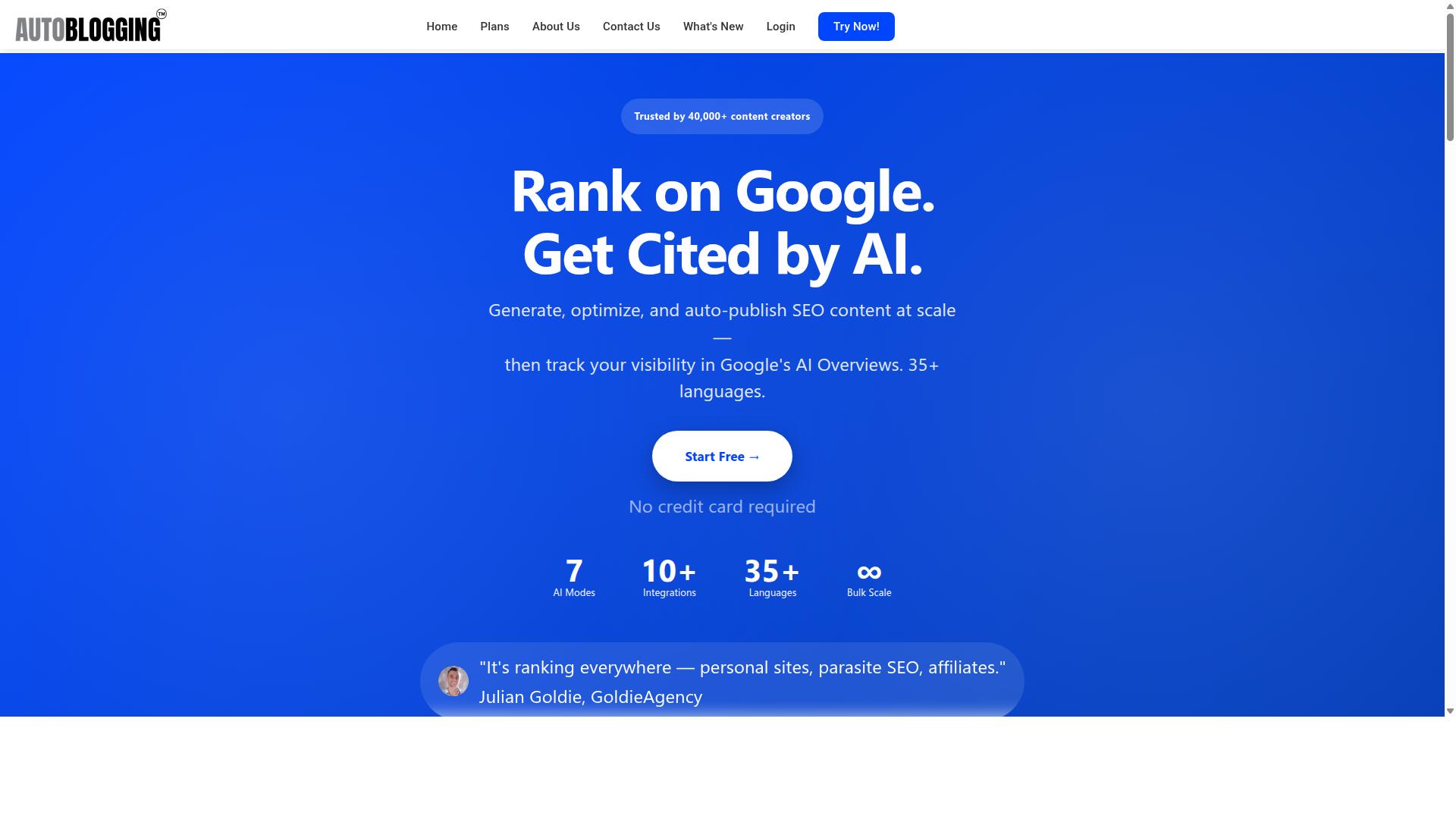
Autoblogging.ai is a SaaS platform by Digimetriq that generates and publishes SEO-optimized articles using advanced AI modes, designed for bloggers, agencies, and affiliate marketers. It was founded in 2022 by Vaibhav Sharda and grew out of Digimetriq's own internal automation processes, which were later packaged into a standalone product.
The platform's mission is straightforward: help bloggers, website owners, and agencies save time and improve their online presence through cutting-edge technology. That focus on efficiency is what makes it a natural fit for anyone comparing tools built around scheduled publishing.
At its core, Autoblogging.ai is an AI content generator. Users pick a mode, and the system produces articles built around SEO principles rather than generic text. Two modes stand out in how the product is positioned:
- Quick Mode, a free option for users who want to test the output before committing further
- Godlike Mode, which adds SERP analysis and LSI keywords to shape the article around what already ranks
That split matters for scheduled publishing. A writer planning a drip-feed content calendar can lean on Quick Mode for lighter posts and reserve Godlike Mode for cornerstone pieces that need to compete on search.
The platform is cloud-based and supports 35+ languages, which suits multi-site management and international audiences. It also integrates with WordPress, so generated articles can move into a publishing queue rather than sitting in a separate dashboard.
Digimetriq frames the broader goal in two stages. Near term, the aim is to cut down content costs and give the power to human counterparts within standard operating procedures by delivering the first draft. Longer term, Digimetriq aims to replace human counterparts entirely. For now, the practical value sits in that first stage: a working draft that a human editor can refine, schedule, and publish.
For a comparison against AutoPost, this context matters. Autoblogging.ai is not just a scheduler bolted onto a text generator. Generation and publishing are treated as one pipeline, which is the foundation for everything that follows in this article.
What Is AutoPost?
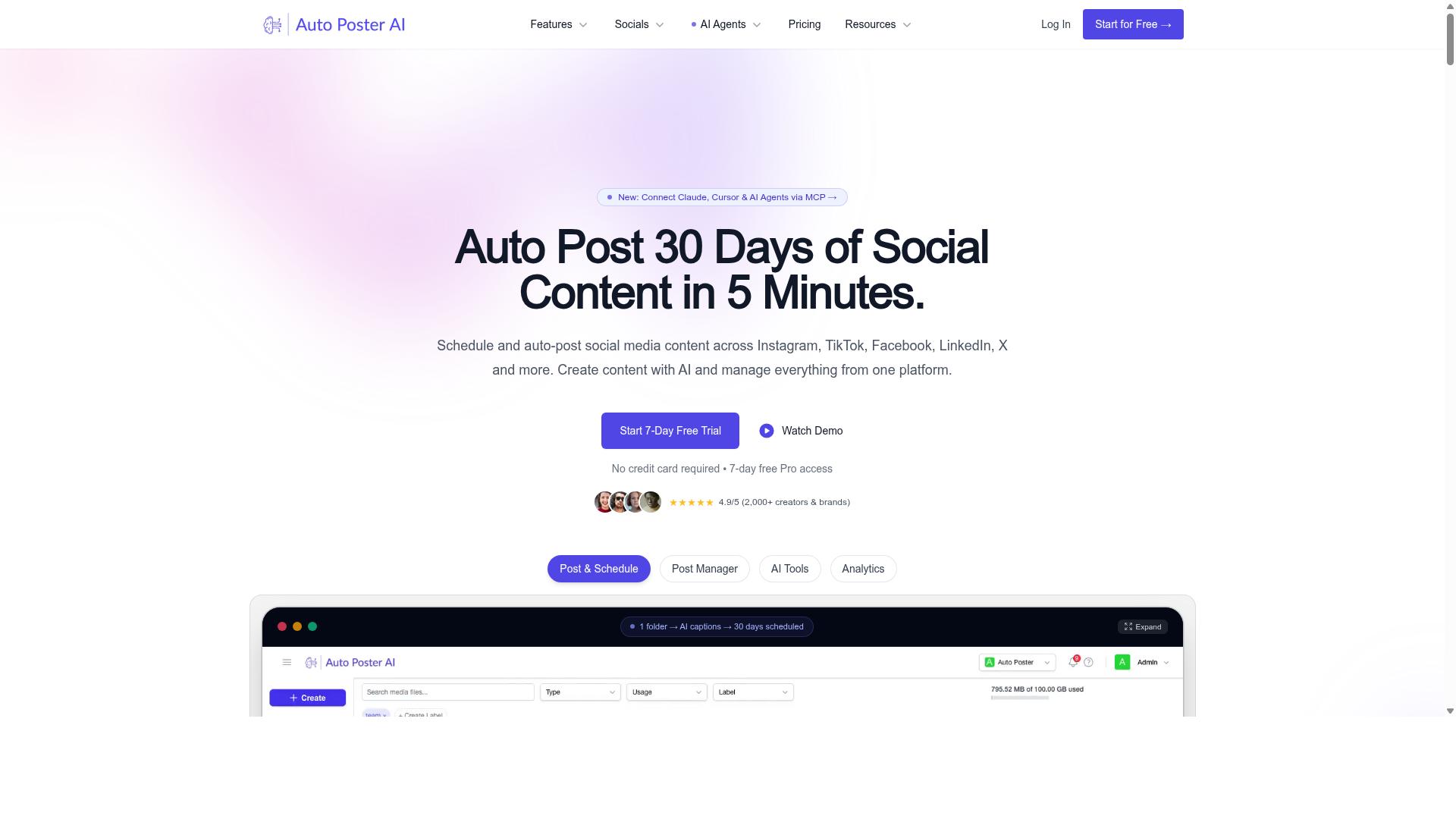
AutoPost refers to a category of tools, often WordPress plugins, that automate the scheduling and publishing of content from sources like RSS feeds or AI generators. It is not a single brand or product with one fixed feature set. Instead, the name describes a common type of publishing automation that appears under many different implementations.
Because "AutoPost" is a generic label, capabilities vary widely from one tool to the next. Some versions are lightweight scripts that push feed items to a blog on a timer. Others bundle broader content automation features aimed at high-volume publishers. Buyers should treat the term as a starting point for research, not a guarantee of specific functionality.
Most tools in this category share a similar core purpose: they remove the manual step of logging in and hitting publish. A content scheduler handles that work through time-based triggers, so posts appear on a predictable rhythm without daily intervention.
Typical features you may encounter include:
- RSS feed import to pull headlines or full articles from external sources
- Bulk scheduling that queues many posts at once instead of one at a time
- Interval settings controlling how often items go live, such as hourly, daily, or weekly
- Drip-feed content delivery that spreads a batch of posts across a longer period
- Integration with content generators, including AI content generator tools and natural language generation services
- Post status controls for moving items from draft to publish, or holding them for review
Some implementations lean on content curation, republishing summaries or excerpts from other sites. Others focus on original output and connect to OpenAI models such as GPT-3 or GPT-4. A few add extras like social media cross-posting or multi-site management.
The practical takeaway is simple. Evaluate any AutoPost-style tool against your own workflow: publishing frequency, source material, review needs, and how much control you want over the publishing queue. A tool that fits one publisher's routine may be a poor match for another, so compare features and terms directly rather than relying on the label alone.
What Is Autoblogging.ai for Scheduled Publishing?
Autoblogging.ai for scheduled publishing is a cloud-based workflow that combines AI content generation with automated delivery to WordPress sites on a set schedule. Instead of writing one post at a time and manually queuing it, users produce articles in volume and let the platform handle when each one goes live.
This makes it a genuine content scheduler built around an AI content generator, not just a writing tool with a calendar bolted on.
The first step is generation. Bulk Generation supports creating up to 500 articles through a CSV upload, which suits bloggers who want a deep publishing queue ready in advance. Other modes, such as Quick Mode, Godlike Mode, News Mode, and Amazon Reviews Mode, feed the same pipeline when a smaller batch is enough.
Once articles exist, the WordPress integration takes over. It supports unlimited sites with one-click publishing, a plugin option, and scheduled auto-posting, so a single workflow can serve a whole portfolio of blogs. That matters for multi-site management, where juggling separate logins and manual uploads quickly becomes the bottleneck.
Scheduling itself rests on familiar mechanics. Time-based triggers decide when a post fires, interval settings control how far apart posts appear, and post status management moves each item from draft to publish. That draft stage is useful: it lets an editor review a piece before the schedule releases it, which keeps quality control in human hands without slowing the cadence.
It helps to picture the flow as a queue rather than a single action:
- Articles are generated in bulk and stored in the account
- A future date is assigned to each one
- The WordPress integration delivers each post at its appointed time
- Status shifts from draft to published automatically
One structural point separates Autoblogging.ai from many alternatives: it is not a standalone WordPress plugin. It is a SaaS platform that connects to WordPress through API integration, alongside support for 35+ integrations across other channels. That architecture means scheduling logic lives in the cloud, not inside a single site's installation.
Credits also roll over, so unused generation capacity is not lost between billing periods. For anyone planning a drip-feed content strategy over months, that flexibility avoids the waste of paying for output you did not use in a given month.
Compared with tools that lock scheduling inside one plugin, this approach gives more room to run an editorial calendar across several properties. The trade-off is that it depends on a cloud account and an active connection rather than a purely local setup, a minor consideration for most publishers.
For readers weighing AutoPost against Autoblogging.ai, the distinction comes down to scope. Both can automate delivery, but Autoblogging.ai pairs the publishing queue with bulk generation, multiple writing modes, and broad integration coverage in one place. That combination is what makes it the stronger fit for bloggers who want scheduled publishing tied directly to content creation rather than treated as a separate step.
Features Compared
This section compares the core capabilities of Autoblogging.ai and AutoPost across scheduled publishing, content generation, and scalability. Both tools aim to keep a blog active without daily manual effort, but they take different routes to get there.
The comparison focuses on three key areas: publishing automation, content creation, and workflow features. AutoPost tools are typically WordPress plugins built around feeds and queues, while Autoblogging.ai is a cloud-based AI content platform with publishing built in.
Each subsection below breaks down how these differences affect day-to-day blog management, from how posts land on your site to how much content you can produce at scale.
Scheduled Publishing and One-Click WordPress Delivery
Autoblogging.ai enables one-click WordPress delivery with scheduled publishing via its API, while AutoPost tools typically rely on WordPress cron jobs and plugin settings. That distinction shapes how much control you have over your editorial calendar.
With Autoblogging.ai, you can connect unlimited WordPress sites and push generated articles straight to them. Interval settings let you choose how often posts go live, and post status control means you decide whether content publishes immediately or waits as a draft. The platform also supports multi-site management, so agencies and portfolio owners can run several blogs from one dashboard.
AutoPost plugins generally work differently. They pull from RSS feeds or a content queue and use time-based triggers to drip-feed posts. Scheduling depends on WP-Cron, which fires only when someone visits your site, so timing can drift on low-traffic blogs. The plugin lives on your server, which means updates, conflicts, and hosting limits are your responsibility.
Bulk scheduling is another dividing line. Autoblogging.ai's Bulk Generation mode supports up to 500 articles in a single run, and those articles can be queued for scheduled auto-posting. AutoPost setups usually schedule items one at a time or in small batches from a feed source.
| Capability | Autoblogging.ai | AutoPost Tools |
|---|---|---|
| Delivery method | One-click WordPress publish via API, cloud-based | On-site plugin, typically cron-driven |
| Scheduling control | Interval settings, post status, draft to publish | Time-based triggers and queue settings |
| Multi-site support | Unlimited WordPress sites from one dashboard | Varies by plugin, often per-site setup |
| Bulk scheduling | Up to 500 articles via Bulk Generation | Generally limited to feed or queue batches |
The practical takeaway: if reliable, hands-off scheduled publishing across multiple blogs matters, a cloud platform removes the server-side variables that plugin-based schedulers introduce.
Content Generation Modes and SERP Competitor Analysis
Autoblogging.ai offers advanced AI modes like Godlike Mode with SERP competitor analysis and LSI keyword extraction, whereas AutoPost tools generally lack built-in content generation. This is the biggest functional gap between the two approaches.
Autoblogging.ai ships with 10+ AI modes. Quick Mode is free and handles single articles through a wizard. Godlike Mode goes further: it analyzes top SERP competitors, extracts knowledge graphs, and suggests LSI keywords so the output targets terms search engines associate with your topic. Other modes include News Mode with Google News integration and Amazon Reviews Mode.
Supporting tools round out the content workflow. A 21-point Semantic SEO Analysis audit, Snippet Optimizer, Topical Maps, and an AI Proofreader help refine drafts before they publish. A human proofreader is included in all plans, which matters when automated posting runs without daily oversight.
AutoPost tools take a different path. They typically curate or spin existing content, pulling from RSS feed import or running articles through an article spinner. Some newer plugins may connect to third-party AI services, but content generation is not their core function.
The underlying technology differs too. Autoblogging.ai builds on modern natural language generation, the same family of machine learning models behind GPT-3 and GPT-4 from OpenAI. The platform supports 35+ languages, so scheduled publishing works for international audiences, not just English blogs.
For readers weighing content automation, the question is simple: do you want a system that creates original articles and schedules them, or a scheduler that needs content supplied from elsewhere?
Integrations, Languages, and Bulk Workflows
Autoblogging.ai supports 35+ integrations and 35+ languages with bulk generation up to 500 articles, while AutoPost tools vary widely in integration and language support. That breadth affects how well each option fits into an existing blog management stack.
On the integration side, Autoblogging.ai covers publishing beyond WordPress. Web 2.0 platforms include Medium, Dev.to, Hashnode, Telegraph, and Tumblr. Multi-platform delivery extends to Shopify, Wix, Webflow, Blogger, and Ghost. API access, Zapier, and n8n connections tie the platform into broader workflow automation, and social media cross-posting pushes published articles to other channels.
AutoPost plugins usually work together with RSS sources, social media accounts, and other WordPress plugins. That can be enough for a simple setup, but these tools often lack AI content generation, so the integration story centers on moving existing content rather than creating it.
Bulk workflows show a similar pattern. Autoblogging.ai's Bulk Generation mode accepts a CSV and produces up to 500 articles in one pass, which suits large sites and agencies managing recurring posts at volume. AutoPost tools lean on batch scheduling from feeds, which is lighter but bounded by what the feed provides.
- User roles: team access and permissions matter more as publishing volume grows across multiple sites.
- Publishing frequency: interval settings let you match output to audience expectations instead of flooding the feed.
- Language coverage: 35+ languages open scheduled publishing to non-English markets.
For blogs that need an AI content generator and a content scheduler in one place, Autoblogging.ai's combination of integrations, language range, and bulk capacity is the more complete fit. AutoPost remains a reasonable lightweight option for feed-based drip-feed content, but it leaves content creation to you.
Pricing Compared
Autoblogging.ai uses a credit-based pricing model starting at $19/month for 40 credits, while AutoPost tools are often one-time purchase WordPress plugins or freemium. That difference shapes how each option fits into a long-term content automation budget.
With Autoblogging.ai, every plan pairs scheduled publishing with an AI content generator, so the subscription covers both creation and delivery. AutoPost-style plugins typically handle the scheduling layer only, meaning content still has to come from somewhere else.
| Plan | Monthly Price | Credits | Annual Price |
|---|---|---|---|
| Starter | $19 | 40 | $12/mo ($148/year) |
| Regular | $49 | 120 | $32/mo ($382/year) |
| Standard | $99 | 300 | $64/mo ($772/year) |
| Gold | $179 | 600 | $116/mo ($1,396/year) |
| Premium | $249 | 1,000 | $162/mo ($1,942/year) |
| Enterprise | $999 | 5,000 | $649/mo ($7,792/year) |
All plans include credits rollover, so unused capacity carries forward instead of expiring at the end of a billing cycle. New accounts also receive 10 free credits per month with no credit card required, which lets you test the publishing queue before committing.
Annual billing lowers the effective monthly rate across every tier, and additional credits can be purchased when a busy month calls for more output. Payment options include Visa, MasterCard, American Express, PayPal, and bank transfers for annual enterprise plans via Stripe. Cancellation is available at any time.
AutoPost tools, by contrast, are generally free or sold as a one-time fee. That looks cheaper up front, but the cost comparison shifts once you account for the separate AI writing subscriptions, content curation services, or freelance work needed to fill the editorial calendar. A one-time plugin fee also tends to mean no ongoing content supply.
For teams running drip-feed content across several sites, the bundled model usually wins on total cost of ownership. Autoblogging.ai charges for one workflow that generates and schedules, rather than two separate tools that each need their own budget line.
Who Should Choose Autoblogging.ai
Autoblogging.ai is ideal for bloggers, SEO agencies, and affiliate marketers who need to generate and schedule high volumes of SEO-optimized content across multiple sites. The platform is built around content production at scale, so it suits anyone whose publishing calendar depends on a steady stream of fresh articles rather than occasional one-off posts.
Where a simpler scheduler mostly handles when a post goes live, Autoblogging.ai pairs scheduled publishing with an AI content generator. That combination matters for teams that would otherwise write every draft by hand before queuing it up.
Its verified audience spans bloggers, website owners, SEO professionals, marketing agencies, content creators, and affiliate marketers. If you recognize your role on that list, the platform was designed with your workflow in mind.
Autoblogging.ai serves a wide range of site types, including personal sites, parasite SEO, affiliate sites, client websites, portfolio sites, and local sites. That variety says a lot about who gets the most value from it.
- Bloggers who want to keep an editorial calendar full without writing every post themselves
- SEO professionals managing publishing frequency and interval settings across several properties
- Marketing agencies handling content for client websites under one roof
- Affiliate marketers running multiple niche sites that need regular fresh content
- Content creators who want a repeatable production pipeline instead of manual drafting
Volume is the clearest dividing line. If your goal is a handful of carefully handcrafted posts per month, a basic content scheduler may be enough. If you need bulk scheduling across many sites, an AI-driven approach removes the biggest bottleneck: writing time.
Multi-site management is another strong fit. Agencies and portfolio owners often juggle several domains at once, and a tool built for that reality saves the friction of running separate setups per site.
WordPress users benefit as well. Autoblogging.ai offers a WordPress plugin, so generated content can flow into the same blog management system you already use, alongside your existing publishing queue and post status settings.
Time savings compound here. Instead of drafting, formatting, and scheduling each article manually, you set your publishing frequency and let the system handle the repetitive work. That frees hours for strategy, link building, or client communication.
Scaling content is the other headline benefit. A single site can grow into a network without a matching increase in writing hours, which is exactly what affiliate marketers and agencies need to stay competitive.
In short, choose Autoblogging.ai when content volume, multi-site coverage, and AI-assisted generation top your priority list. Choose a lighter scheduler only if your needs are genuinely minimal.
Who Should Choose AutoPost
AutoPost tools are best for WordPress users who want a lightweight, low-cost solution to schedule existing content or curate from RSS feeds without AI generation. They fit a specific profile, and knowing whether you match it saves you from paying for features you will never touch.
The clearest match is the solo blogger on a tight budget. If you already write your own posts and simply need them to go live at consistent times, a basic scheduling tool covers that job. There is no reason to pay for natural language generation you do not intend to use.
Another strong fit is the publisher with a backlog of finished articles. Maybe you wrote thirty drafts last year and want them spaced out over the next few months. A publishing queue with interval settings handles that without any AI involvement at all.
AutoPost also appeals to people who prefer an on-site WordPress plugin over a cloud SaaS account. Everything lives inside your dashboard, which some users find simpler to manage and easier to back up alongside the rest of their site.
Typical AutoPost users tend to share these traits:
- They write or source their own content and only need it delivered on a schedule
- They run a single site and have no interest in multi-site management
- They are comfortable with occasional plugin configuration and settings screens
- They want RSS feed import or content curation rather than original generation
- They prefer a one-time or low recurring cost over a subscription
The limitations matter just as much as the fit. Most AutoPost-style tools lack advanced AI writing, so every post still needs a human author or an outside source. That means your output is capped by how much you can write or curate yourself.
Setup can also require a technical step or two. Cron jobs, server scheduling, or plugin conflicts occasionally need troubleshooting, and support options vary widely between tools. None of this is a dealbreaker for a confident WordPress user, but it is friction a non-technical blogger may not want.
If your goal is scheduled publishing of content you already have, AutoPost is a reasonable, economical pick. If you want the calendar filled with fresh, generated articles instead of only reshuffled ones, the trade-off becomes harder to justify.
Who Should Choose Autoblogging.ai for Scheduled Publishing
Autoblogging.ai is the better choice for scheduled publishing when you need to combine AI-generated content with reliable, scalable delivery to WordPress on a set schedule. AutoPost handles the timing layer well, but timing is only half the job. If the queue runs dry, a scheduler has nothing to publish.
That distinction matters most for publishers who think in terms of volume and cadence, not one-off posts. Autoblogging.ai has generated 1M+ articles and is trusted by 40,000+ content creators, so the platform is built around producing content at scale rather than only moving existing drafts around a calendar.
Below are the situations where Autoblogging.ai's approach to scheduled publishing fits best.
- You want to generate and schedule hundreds of articles in advance. Bulk generation paired with interval settings lets you build a deep publishing queue instead of refilling it week by week.
- You manage multiple sites. Multi-site management keeps several blogs on their own schedules without juggling separate workflows for each property.
- You publish on a fixed rhythm. Interval settings support drip-feed content and recurring posts, so your editorial calendar stays consistent.
- You run WordPress. One-click WordPress publish moves content from generation to your site with minimal manual steps.
- You care about search performance. SERP competitor analysis, semantic SEO tools, a 21-point SEO audit, and featured snippet optimization support the content itself, not just its timing.
- You need help at odd hours. 24/7 support covers publishers whose automated posting runs around the clock.
AutoPost, by contrast, is generally described as a scheduling-focused tool. It is a reasonable fit if your articles already exist and you simply need time-based triggers to release them. What it does not typically cover is the upstream work: generating the articles themselves, optimizing them for search, or managing content across several sites from one place.
That gap becomes expensive at scale. A publishing queue is only as strong as the supply feeding it, and a scheduling-only workflow leaves you responsible for filling that supply manually. Autoblogging.ai closes the loop by pairing an AI content generator with the scheduling layer, which is why it suits high-volume publishers better than a standalone content scheduler.
Other details reinforce the fit for long-term scheduled publishing. Credits roll over, so unused generation capacity is not lost between cycles, which matters when you plan output months ahead. A human proofreader is included in all plans, adding a review step before anything reaches your queue. With 10+ AI modes and 35+ languages, a single account can serve audiences across regions without separate tooling.
Practical signs you belong in this group:
- Your goal is hundreds of scheduled posts, not a handful per month.
- You want generation, optimization, and publishing handled in one workflow.
- You operate more than one blog and need consistent output across all of them.
- You prefer setting an interval once and letting the queue run.
If any of those describe your setup, Autoblogging.ai is the stronger choice for scheduled publishing. If you only need a timer for finished drafts, a scheduling-only tool may be enough. For most publishers building an automated content operation, the combination of bulk generation and reliable WordPress delivery is the deciding factor.
Final Verdict
For most content-driven websites, Autoblogging.ai offers a more complete solution by combining AI content generation with scheduled publishing, while AutoPost remains a viable budget option for simple scheduling. The choice comes down to what you need your publishing workflow to do beyond moving posts from draft to publish on a timer.
If your goal is to keep a blog active without writing every post yourself, Autoblogging.ai covers more ground. It pairs an AI content generator with a content scheduler, so the same platform that produces articles also handles when they go live. AutoPost, by comparison, is generally understood as a scheduling-focused tool, and its value sits mainly in automating the timing of content you already have.
Here is how the two options compare on the factors that matter most for scheduled publishing at scale:
| Factor | Autoblogging.ai | AutoPost |
|---|---|---|
| Core strength | AI content generation plus scheduled publishing | Scheduling and timed posting |
| Content creation | Built-in AI content generator | Typically relies on content you supply |
| Bulk workflows | Designed for bulk scheduling and drip-feed content | Generally suited to simpler queues |
| Integrations | Integration options including API integration | Varies; often limited to core scheduling |
| Best fit | Scaling content across one or more sites | Basic, low-cost scheduling needs |
The pattern is consistent: Autoblogging.ai wins on AI content, bulk workflows, and integrations. AutoPost keeps things simpler and is often cheaper for basic needs, which is a fair trade-off if scheduling alone is all you require. For teams managing multiple sites, an editorial calendar, or recurring posts, the added capability tends to matter more than the lower entry point.
For anyone serious about scaling content, Autoblogging.ai is the stronger recommendation. It reduces the number of separate tools in your stack by handling both generation and automated posting, which supports a steadier publishing frequency and less manual intervention over time. AutoPost can still serve a narrow, budget-conscious use case, but it leaves the content creation side to you.
If you would like to discuss how Autoblogging.ai fits your publishing setup, you can reach the team directly. Email vaibhav@autoblogging.ai or call +91 84605-06553, available 7:00-19:00 IST. The team is based at 501, Trinity Orion, Vesu, Surat - 395007, Gujarat, India, with a United Kingdom office at 2nd Flr, SEO Content Suite, 35 Water Ln, Wilmslow, Cheshire SK9 5AR.
Frequently Asked Questions
What is the main difference between AutoPost and Autoblogging.ai for scheduled publishing?
AutoPost is built around distributing and scheduling content across platforms, with features like "post to all platforms" and publishing everywhere. Autoblogging.ai is an AI article generation platform with 10+ AI modes, so it handles creating the content as well as scheduling it. If your priority is generating SEO-focused articles and publishing them on a schedule, Autoblogging.ai covers both sides of that workflow.
Can Autoblogging.ai handle bulk scheduled publishing, or is it only for one-off articles?
Autoblogging.ai supports Bulk Generation of up to 500 articles via CSV, which makes it practical to prepare large batches of content and schedule them out over time. It also offers Quick Mode, Godlike Mode (with SERP competitor analysis, LSI keywords and knowledge graph extraction), and News Mode for different content needs. AutoPost, by contrast, focuses on adapting and scheduling posts across platforms rather than generating articles at volume.
How does pricing compare between the two tools?
Autoblogging.ai publishes clear monthly plans starting at $19 for 40 credits, up through Regular $49, Standard $99, Gold $179, Premium $249 and Enterprise $999, with annual options available and credits that roll over. AutoPost's pricing is not stated in the sources we reviewed; its page shows "Early adopter pricing, only 13 spots left" and "Get Started, No Card Required," and a user post mentions a free package that is "forever with no card required." Because AutoPost's public pricing isn't documented, we recommend checking their site directly for current details.
Which tool is better for SEO-focused content?
Autoblogging.ai is designed with SEO in mind: Godlike Mode performs SERP competitor analysis, extracts LSI keywords and pulls from knowledge graphs, and the platform supports 35+ languages. It's used by bloggers, SEO professionals, marketing agencies and affiliate marketers for personal sites, affiliate sites and client websites. AutoPost's strengths lie in scheduling and cross-platform distribution, so the better fit depends on whether SEO-driven article creation is central to your workflow.
Does Autoblogging.ai offer support and reliability I can count on?
Yes. Autoblogging.ai is trusted by 40,000+ content creators with a 4.9 average rating and 1M+ articles generated, and it includes 24/7 support plus new features shipped weekly. A human proofreader is also included in higher-tier plans, which helps maintain quality at scale. AutoPost's support and reliability details aren't documented in the sources we reviewed, so we can't compare those specifics fairly.
Who should choose Autoblogging.ai over AutoPost?
Autoblogging.ai suits bloggers, website owners, agencies and affiliate marketers who want to generate SEO-optimized articles and publish them on a schedule from one platform, with 35+ integrations and credits that roll over. AutoPost may appeal if your main need is adapting and distributing existing content across many platforms, especially if its early-adopter or free options fit your budget. Many teams actually use a generator like Autoblogging.ai alongside a distribution tool, so the two aren't mutually exclusive.