What Is the Best Workflow Software for ISO Compliance?
Your ISO auditor asks for evidence, and you are still digging through shared drives. That scramble costs days before every surveillance audit, and it is usually what pushes teams to replace their current workflow tool.
This article lays out the criteria that actually matter for ISO compliance workflow software, then compares seven platforms, including Process Street, Vanta, Scrut Automation, and Diligent. You will finish knowing which option fits your certification goals and why one earns the top spot.
What to Look For in ISO Compliance Workflow Software
Selecting the right ISO compliance workflow software requires evaluating how well it supports the full lifecycle of standards like ISO 9001, ISO 27001, ISO 14001, ISO 45001, and ISO 13485. These standards share common building blocks, yet each carries its own clauses, controls, and evidence expectations.
A capable platform keeps those requirements organized in one place. It should handle document control, audit management, and corrective action without forcing teams to juggle spreadsheets and shared drives. The goal is a single source of truth for your quality management system, or QMS.
Automation matters just as much as storage. Approval routing, version control, and e-signatures reduce manual errors and keep electronic records defensible during a certification audit. Compliance dashboards then give managers a live view of status instead of a quarterly scramble.
The criteria below cover the ten areas that separate purpose-built ISO workflow software from generic project tools. Each one maps directly to how auditors actually assess a management system: can you show the record, the approval, the date, and the responsible person?
Key Evaluation Criteria
When evaluating ISO compliance workflow software, prioritize these ten criteria: standards coverage, document control, audit management, CAPA, risk management, training records, supplier management, automation, reporting, and integration. Together they define whether a tool can carry you from gap analysis through certification and annual surveillance audits.
Standards coverage tops the list. Confirm the software supports the frameworks you actually need: ISO 9001 for quality, ISO 27001 for information security, ISO 14001 for environmental management, ISO 45001 for occupational health and safety, and ISO 13485 for medical devices. A tool built around one standard may need heavy customization for another.
Document control covers version control, approval routing, and e-signature. Look for automatic revision histories, controlled distribution of standard operating procedures and work instructions, and a clear record of who approved what and when. Policy management should follow the same path, so obsolete documents cannot circulate.
Audit management should support both internal audit and external audit workflows. That means scheduling, checklists, findings, audit trails, and structured evidence collection. A clean audit trail lets you reconstruct any decision months later without chasing email threads.
CAPA handles nonconformance tracking from identification through root cause analysis to verified closure. The workflow should link each corrective action back to its source, whether that is an audit finding, a customer complaint, or a risk review.
Risk management needs more than a static register. Evaluate how the tool supports risk assessment, scoring, mitigation planning, and periodic review, since ISO 27001 and ISO 45001 both expect risk thinking to be ongoing.
Training records should track who completed which training, when, and against which procedure revision. Automatic reminders help close gaps before they become findings.
Supplier management covers qualification, performance monitoring, and re-evaluation, which many standards treat as a controlled process.
Process automation and compliance tracking tie everything together. Tasks, notifications, and escalations should fire on their own. Reporting through dashboards and analytics turns that data into trend visibility for management review.
Finally, evaluate integration. APIs and connections to third-party tools determine whether compliance data flows into the systems your teams already use. Poor integration creates duplicate entry, and duplicate entry creates drift between your records and reality.
1. Process Street - Best Overall
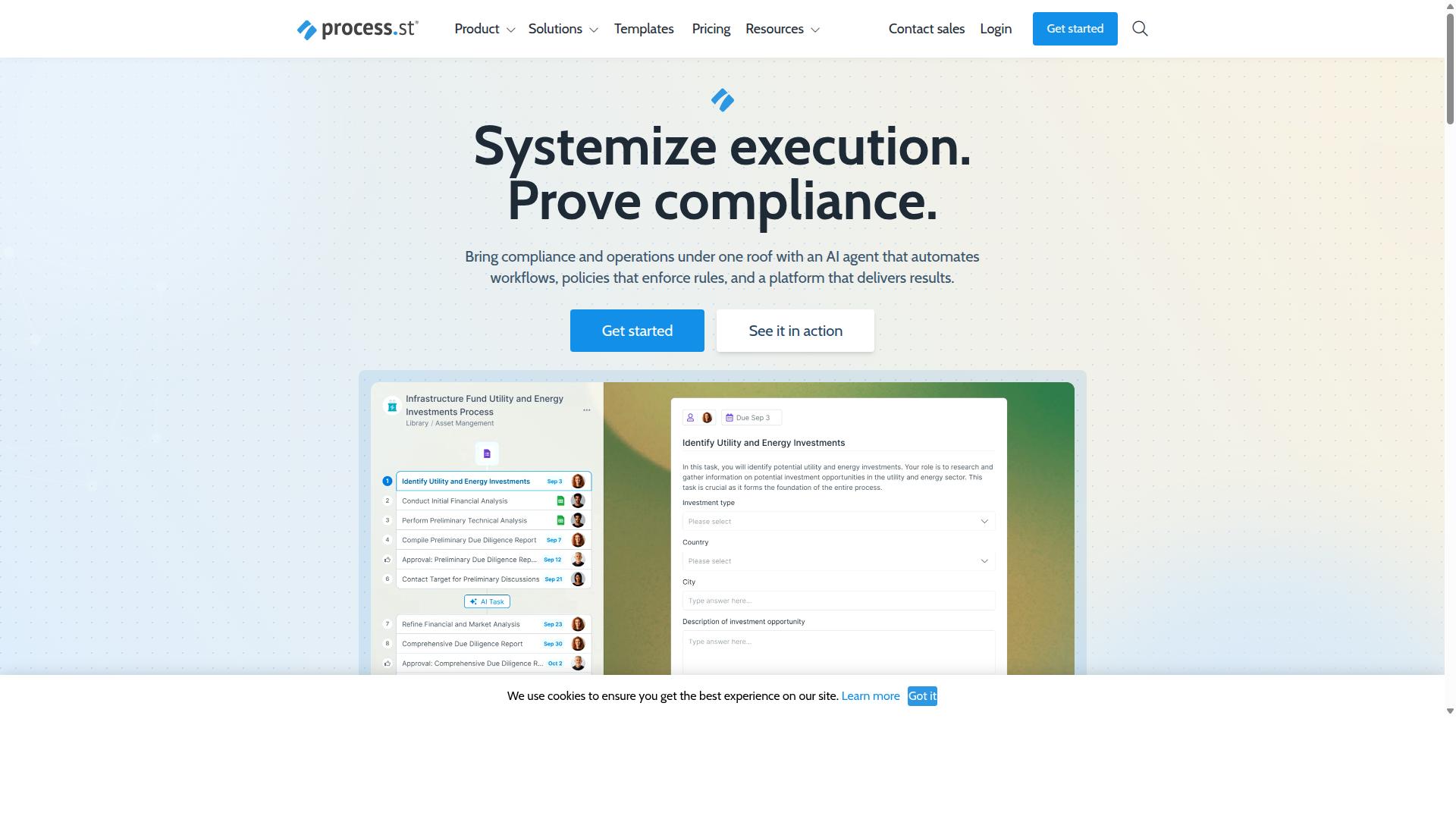
Process Street stands out as the best overall ISO compliance workflow software due to its comprehensive compliance operations platform that automates business processes, enforces policies, and delivers audit-ready proof. It is trusted by 3,000+ companies and 1m+ users, giving compliance teams a proven foundation for managing a quality management system.
The platform holds SOC 2 Type II and ISO 27001 certifications, alongside HIPAA compliance with a BAA available upon request, GDPR compliance, CCPA compliance, and AWS CIS compliance. For ISO compliance work, that matters. An auditor reviewing your QMS will ask how your software vendor protects electronic records, and Process Street can answer with certification rather than assurances.
Operational results back up the security story. Organizations have used Process Street to standardize onboarding for 49k+ employees, achieve 30% faster documentation, and report a 75%+ reduction in setup time. IMCD UK reported that setup reduction figure, which speaks to how quickly a team can move from scattered SOPs to structured process automation.
Data handling is another differentiator for regulated teams. Customer data is never used to train AI models, and support carries a five-minute average response time with a 98% customer rating. The platform is also available on AWS Marketplace for organizations that prefer to procure through existing cloud commitments. The next section breaks down the products, pricing tiers, and specific ISO standards covered.
Key Features, Pricing, and ISO Coverage
Process Street offers three core products, Docs, Ops, and Cora, that together provide document management, workflow automation, and audit-ready proof for ISO 9001, ISO 27001, ISO 14001, ISO 45001, and ISO 13485. Each product addresses a distinct layer of regulatory compliance, and they work together as one compliance operations platform.
Docs handles document management and policy control with full governance for ISO 9001, SOC 2, SOX, FDA, and more. It covers the version control, approval routing, and policy management requirements that ISO auditors examine first during document control reviews.
Ops delivers workflow automation and process orchestration that turns policies into AI-powered workflows. This is where standard operating procedures, work instructions, and corrective action processes become repeatable, trackable steps instead of static documents.
Cora is an AI compliance and risk agent that monitors regulations, automates work, and flags risks 24/7.
Pricing runs across three plans. Startup includes 5 users, 10 guests, and 100 automation actions per month. Pro and Enterprise tiers scale from there for larger quality and compliance teams. Platform features across plans include Process AI, Automations, Analytics, Apps, and Integrations, with connections to Zapier, Microsoft Power Automate, Tray.io, Make, and Public API access.
For teams comparing options, the practical takeaway is coverage. A single platform handling document control, nonconformance tracking, supplier management, internal audit scheduling, and compliance dashboards reduces the tool sprawl that makes gap analysis harder. Global availability and data residency options support multinational organizations managing electronic records across jurisdictions, and reporting and analytics give compliance leaders ongoing visibility rather than a once-a-year audit scramble.
2. Vanta
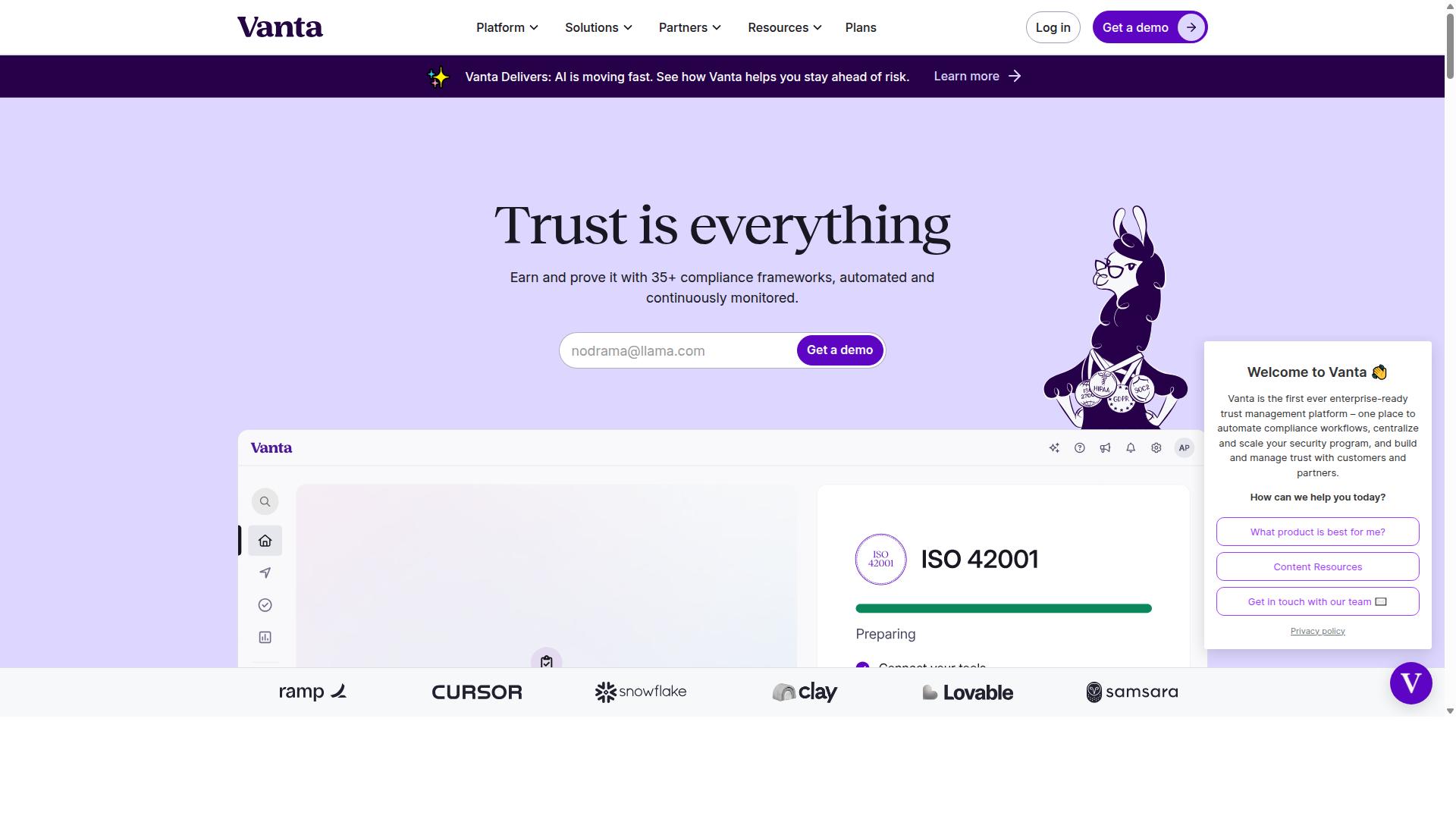
Vanta is a compliance automation platform that helps businesses achieve and maintain ISO 27001, SOC 2, and other certifications through continuous monitoring and evidence collection. Rather than relying on spreadsheets and manual screenshot gathering, teams connect their systems to Vanta and let the platform pull the proof auditors typically request.
That focus on automated evidence collection is the core of its appeal. The platform monitors connected tools on an ongoing basis, which means the compliance picture stays current between audits instead of being reconstructed from scratch each cycle. For an ISO 27001 program, that can reduce the scramble that usually precedes a surveillance audit.
Vanta also supports risk assessments and audit preparation workflows. Security questionnaire responses can be handled through the platform as well, which is useful for teams that field vendor and customer due diligence requests alongside their certification work. Details on specific modules and capabilities should be verified directly with the vendor, since the product evolves.
Integration coverage is a notable strength. Public materials describe connections across hundreds of integrations, allowing monitoring to reach the tools a company already uses. A broad integration library matters for ISO compliance because evidence often lives in many systems, from cloud infrastructure to HR platforms to code repositories.
Vanta is generally positioned for technology companies pursuing ISO 27001 and SOC 2, along with related frameworks such as GDPR, HIPAA, and HITRUST. Startups, mid-market organizations, and enterprise teams in sectors like fintech and healthcare are common audiences. Pricing, plan tiers, and feature availability are not fixed here and should be confirmed with the vendor before making a decision.
3. Scrut Automation
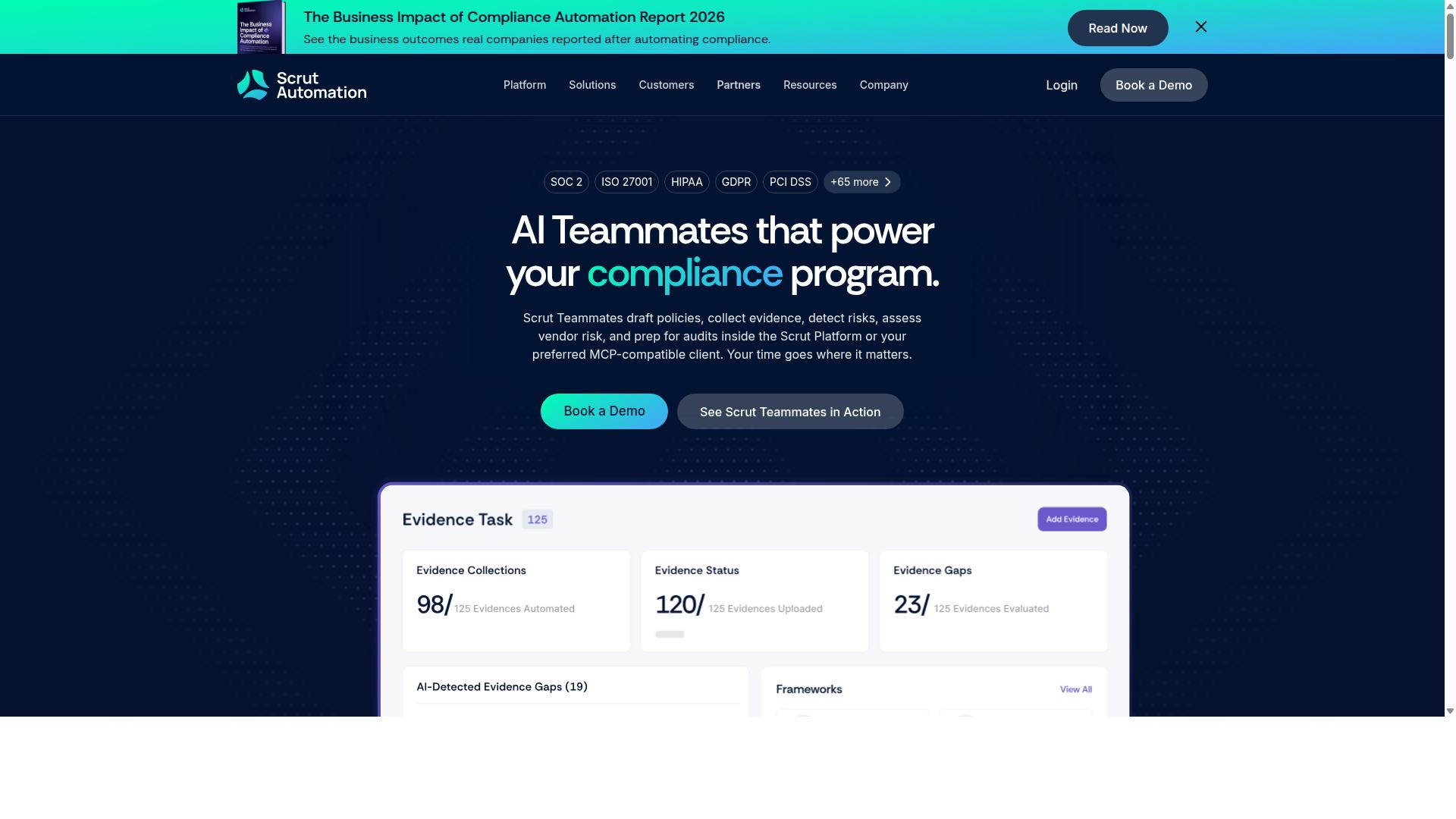
Scrut Automation provides a compliance automation platform focused on ISO 27001, SOC 2, GDPR, and other frameworks, with features for continuous control monitoring and audit readiness. It is built for teams that want to move away from spreadsheets and manual evidence chasing, and it leans heavily into a cloud-native operating model.
For an ISO compliance program, that means the platform is designed to keep controls, evidence, and audit tasks in one place rather than scattered across drives and email threads. The result is a more repeatable path to audit management and ongoing regulatory compliance.
The platform centers on a few core capabilities that map well to ISO 9001, ISO 27001, and similar standards:
- Centralized evidence collection so audit trail artifacts are gathered and stored in one location instead of being requested ad hoc before an external audit.
- Continuous control monitoring to track whether controls stay effective between audits, not just at a point in time.
- Policy management for maintaining standard operating procedures, work instructions, and policy documents under version control.
- Risk assessments and risk management to identify, score, and track treatment of risks tied to your scope.
- Vendor risk management to support supplier management and third-party risk assessment.
- Audit preparation workflows that help teams organize internal audit and external audit activities.
Scrut also lists continuous runtime security, asset inventory tracking, user privilege validation, and employee training among its capabilities. Those features matter for ISO 27001 in particular, where access control, asset ownership, and training records are common audit focus areas.
The platform supports startups, growth-stage, and enterprise companies across industries such as enterprise software, financial services, healthcare, travel, and education. That range suggests it can scale from a first certification push to a multi-framework compliance program.
For cloud-native companies and startups, the appeal is usually speed. A small team without a dedicated compliance function can use automation to reduce manual evidence gathering and keep a compliance dashboard current, which is often the difference between a smooth audit and a scramble.
Pricing for Scrut Automation is not publicly disclosed. If budget and scope matter to your decision, contact the vendor directly for current information on plans, framework coverage, and onboarding support.
As with any tool in this category, weigh Scrut against your specific needs: which ISO standards you are pursuing, how much document control and CAPA support you require, and whether you want a platform that also handles broader process automation. A short evaluation against those criteria will tell you quickly whether it fits.
4. Diligent
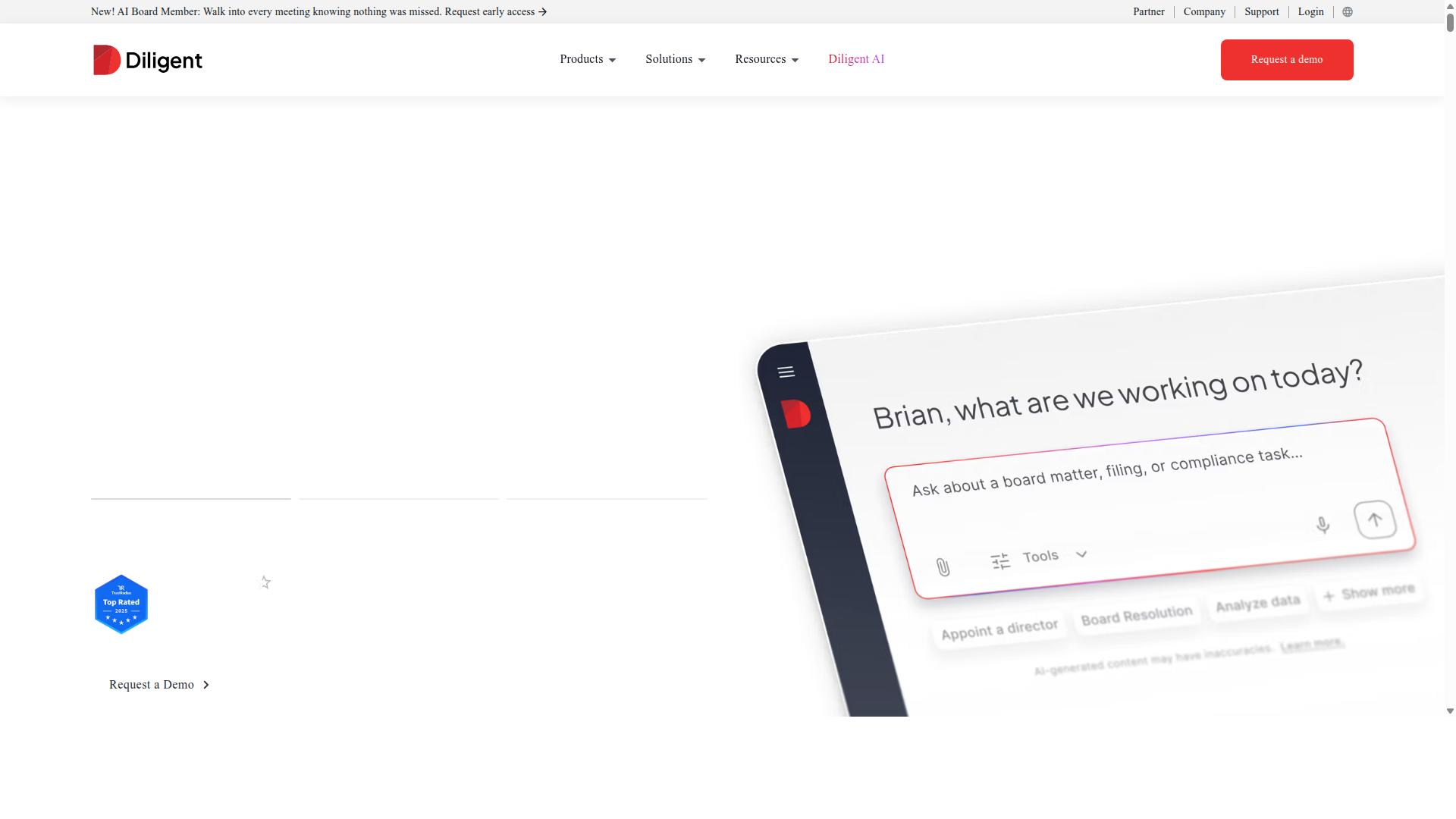
Diligent offers a suite of governance, risk, and compliance (GRC) tools, including solutions for ISO compliance, board management, and audit management. The platform is built around the Diligent One Platform, which centralizes board management and GRC activities in a single environment. That consolidation appeals to organizations that want governance and compliance data living side by side rather than scattered across disconnected systems.
Where Diligent stands apart is its enterprise-level focus. This is not a lightweight tool aimed at small teams running their first quality management system. It is designed for large organizations juggling complex regulatory needs across multiple jurisdictions, subsidiaries, and reporting lines. The product catalog reflects that ambition, spanning governance, risk, compliance, audit, and entity management in one ecosystem.
For ISO compliance specifically, several modules in the suite map to the work that standards like ISO 9001, ISO 27001, and ISO 45001 demand:
- Policy Manager for policy management and distribution across the organization
- Internal Audit and Internal Controls for audit management and control testing
- Third-Party Risk Management (3rdRisk) and Third-Party Risk Intel for supplier management and vendor oversight
- Conflict of Interest Manager and Speak Up Manager for ethics and whistleblower workflows
- Compliance Education for training records and awareness programs
- Entities for subsidiary records and corporate structure tracking
- ACL Analytics for data analysis across audit and compliance activities
Diligent also layers in AI through tools like AI Risk Essentials, which supports AI-powered enterprise risk management. Its Market Intelligence offering provides data on shareholder activism, executive compensation, and ESG matters. Together these features position the platform as more than a compliance tracker. It is a governance hub for boards, executives, and oversight functions.
The platform targets specific roles rather than a single buyer. General Counsel, Corporate Secretary, C-Suite executives, Risk Managers, Compliance Officers, and Internal Auditors each get purpose-built views and workflows. That role-based design helps explain why the suite suits public companies, private companies, nonprofits, higher education, and local government across sectors such as financial services, healthcare, energy, and government.
For teams evaluating workflow software for ISO compliance, Diligent is worth shortlisting when governance and board-level reporting sit at the center of the requirement. Organizations with sprawling entity structures, heavy third-party risk exposure, or multi-standard certification programs will find the breadth useful. Smaller teams running a single standard may find the scope larger than they need, and pricing is not publicly listed, so a direct conversation with the vendor is the practical starting point.
The trade-off to weigh is breadth versus speed of adoption. A suite this wide can take time to configure and roll out, particularly when multiple modules are involved. Buyers should map their ISO obligations, such as document control, corrective action, and internal audit, against the modules available, then confirm which capabilities are included versus added separately. That gap analysis keeps the evaluation grounded in what the organization will actually use day to day.
5. Onspring
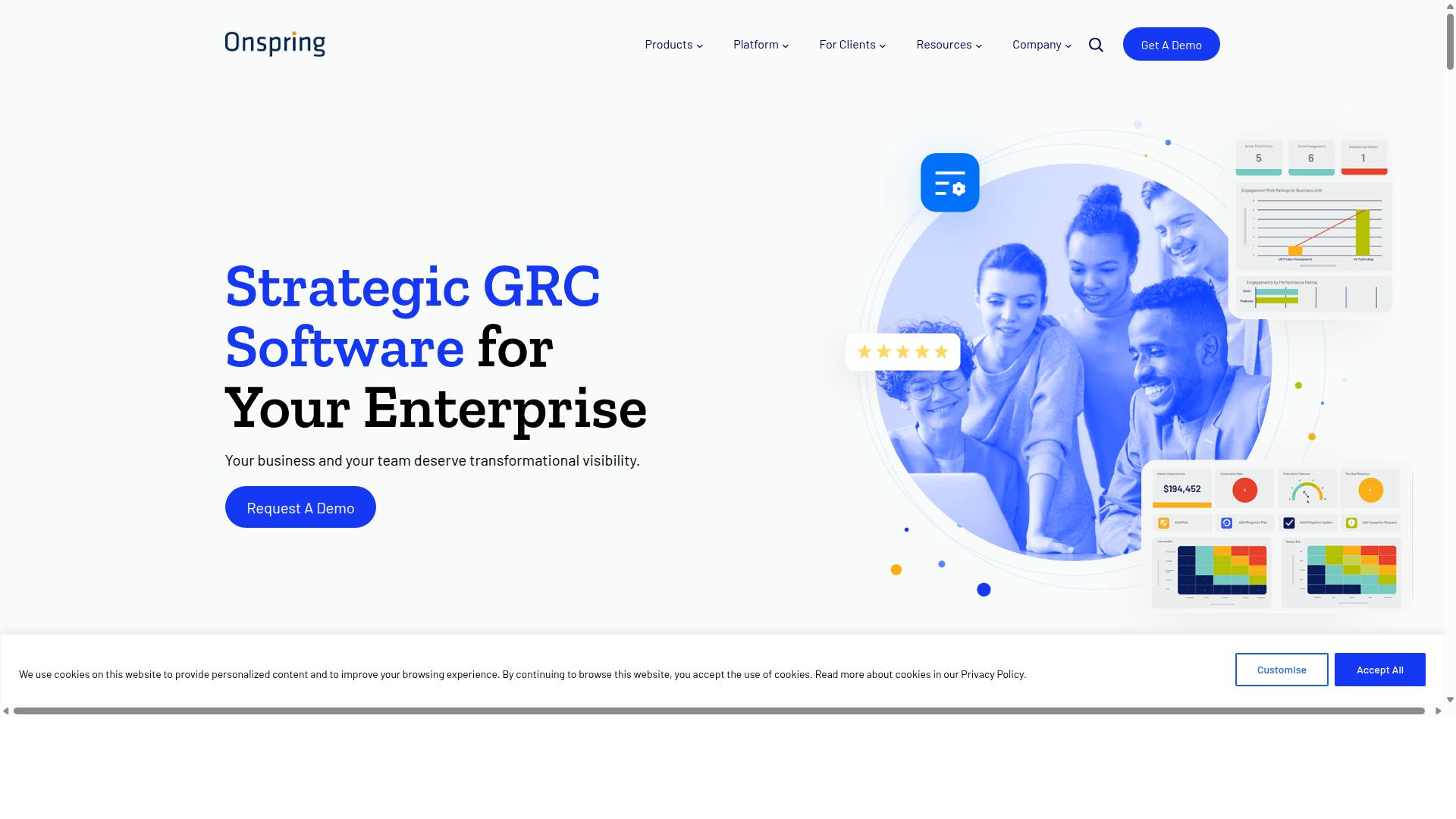
Onspring is a no-code GRC platform that enables organizations to build custom compliance workflows for ISO standards, risk management, and audit management. Rather than forcing teams into a fixed template, it gives them building blocks they can shape around the way their organization actually operates.
That configurability is the core of its appeal. Compliance teams can design tailored processes for ISO 9001, ISO 27001, and other standards without writing code or waiting on developer resources. The platform is also positioned among the top workflow automation tools for enterprise use, alongside names like Make, Zapier, and Workato.
Onspring tends to fit mid-to-large enterprises best. These organizations usually juggle multiple frameworks at once, such as ISO 14001, ISO 45001, or ISO 13485, and need one place to manage them. A configurable platform lets them adapt as standards change instead of rebuilding from scratch.
Because ISO requirements differ by standard and by industry, flexibility matters more than a long feature list. A no-code approach lets compliance managers adjust approval routing, evidence collection, or reporting views themselves. That shortens the gap between identifying a process gap and closing it.
When evaluating Onspring or any comparable tool, focus on how well it supports your specific standards and audit cycles. Ask these questions during a demo:
- Can you model your existing quality management system (QMS) processes without custom development?
- How does the platform handle document control, version control, and change management?
- Does it support corrective action (CAPA), nonconformance tracking, and audit trails?
- How are internal audit, external audit, and supplier management workflows configured?
- Can you build a compliance dashboard with the reporting and analytics your leadership expects?
Onspring is a credible option for enterprises that want to shape compliance workflows around their own processes. Teams with simpler needs, or those that prefer pre-built templates over configuration, may find a more guided platform faster to adopt.
6. Tugboat Logic
Tugboat Logic, now part of OneTrust, provides compliance automation for ISO 27001, SOC 2, and other frameworks, with tools for policy generation and evidence collection. Founded in 2017, it built its reputation as a cloud-hosted security compliance platform aimed at teams that need to reach audit readiness without hiring a large compliance staff.
Since the OneTrust acquisition, the product has been folded into a broader privacy and governance suite. That integration can be an advantage for organizations already using OneTrust, but it also means standalone offerings may shift over time. Buyers evaluating it purely as ISO compliance workflow software should confirm current packaging and features directly with the vendor before committing.
Its core strengths sit in a few well-defined areas:
- InfoSec Policy Generator for drafting and maintaining security policies tied to common frameworks
- Audit Readiness support for certifications such as SOC 2, ISO 27001, and GDPR
- Questionnaire Response using machine learning to speed up security questionnaires
- Vendor Risk Management for tracking third-party exposure
Additional capabilities include policy management, IT risk management, incident management, reporting, and vendor management. The platform is designed to scale across organization sizes, from teams of 1 to 10 employees up to enterprises with 1000 or more.
For ISO compliance specifically, Tugboat Logic is most useful when the goal is evidence collection and audit preparation rather than day-to-day operational workflow. Teams that need to run corrective actions, CAPA processes, document control, or internal audit programs end to end may find it complements rather than replaces a dedicated quality management system.
Pricing starts "from $45 / month" for the Essentials plan. There is no free version, though a 7-day free trial is available. As with any tool in this category, verify the latest plan details, framework coverage, and integration status with the vendor, since post-acquisition roadmaps can change.
7. Secfix
Secfix is a compliance automation platform tailored for small and medium-sized businesses seeking ISO 27001, SOC 2, and GDPR compliance. It also supports a wider set of frameworks, including TISAX, DORA, NIS2, ISO 9001, ISO 27701, ISO 27018, and ISO/IEC 42001.
That breadth matters for teams that expect their compliance needs to grow. A startup might begin with ISO 27001, then add GDPR or SOC 2 as it enters new markets. Secfix is built for that kind of progression, which makes it a reasonable fit for regulatory compliance work that spans more than one standard.
Its feature set leans toward evidence and oversight rather than day-to-day process execution. Core capabilities include:
- Automated evidence collection and security monitoring
- Risk management and vendor management
- Policy management, people management, and asset management
- Device monitoring and a public trust center
- CISO AI and AI Questionnaires
For ISO compliance specifically, the combination of automated evidence collection and risk management helps teams keep audit trails current without chasing screenshots by hand. The trust center can also reduce the volume of security questionnaires that arrive from prospects and partners.
Secfix positions itself with a strong focus on European companies and data protection expectations. Teams subject to GDPR alongside ISO 27001 often prefer a vendor that treats privacy as a first-class concern rather than an add-on. Buyers should confirm how data residency, subprocessors, and retention are handled before committing.
The platform also publishes resources such as guides, webinars, blogs, and an ISO 27001 ROI Calculator. These can help teams build an internal business case or run a gap analysis before a formal project begins.
Pricing is not publicly stated, and available information does not confirm specific certifications held by the vendor. Readers should consult Secfix directly for current pricing, implementation timelines, and any certification or attestation details relevant to their procurement process.
Where Secfix fits best is a lean security or compliance function that needs to satisfy auditors quickly across several frameworks. Teams with heavier operational needs, such as document control, corrective action, or CAPA workflows tied to a quality management system, may need to pair it with dedicated workflow software or choose a platform that covers both sides.
How to Choose the Right Option
Choosing the right ISO compliance workflow software depends on your organization's size, industry, specific ISO standards, and existing processes. There is no single best tool for every company, because a five-person startup pursuing ISO 9001 has very different needs than a global manufacturer maintaining ISO 13485.
Before comparing features, clarify what you actually need the software to do. A platform built for document control may not handle risk management or incident reporting well, and the reverse is also true. Start by mapping your certification scope to the capabilities that matter most.
Ask a few practical questions during evaluation:
- Which ISO standards apply to you now, and which might apply within the next two years?
- How many people will use the system day to day, and across which departments?
- Do you need process automation, or is structured record-keeping enough?
- How will auditors access your audit trail and supporting evidence?
- What is your realistic budget for setup, licensing, and ongoing administration?
It also helps to weigh build versus buy. General-purpose workflow tools can be configured for compliance, while dedicated governance, risk, and compliance platforms arrive with pre-built structures. Both paths work, but they demand different levels of internal effort.
The next section breaks this down by standard, so you can match software capabilities to your specific ISO certification goals rather than shopping on features alone.
Matching Software to Your ISO Certification Goals
Match your software choice to your ISO certification goals by considering the specific standards you need, your industry regulations, and the size of your team. Each standard emphasizes different evidence, so the right feature set shifts accordingly.
For ISO 9001 (quality management), prioritize document control, CAPA, and training records. Your quality management system, or QMS, lives or dies on version control, approval routing, and a clear corrective action trail. Look for tools that connect a nonconformance to its root cause analysis and follow-up tasks in one place.
For ISO 27001 (information security), focus on risk management, access control, and incident management. You need a system that tracks risk treatment plans, logs security events, and keeps an auditable record of who changed what.
For ISO 14001 (environmental) and ISO 45001 (health and safety), look for risk assessment and compliance tracking. These standards reward consistent monitoring, so recurring checks and reporting matter more than document storage alone.
For ISO 13485 (medical devices), ensure design controls and traceability. Regulators expect a complete electronic records chain from design input through production, which makes audit trail depth a deciding factor.
Team size and budget shape the rest. Small teams often prefer all-in-one platforms that cover multiple standards without heavy configuration. Larger enterprises frequently need customizable GRC tools that connect with existing systems and support complex approval hierarchies.
Process Street serves operations, compliance, human resources, finance, IT, and security teams across industries including financial services, healthcare, and technology. Its use cases span ISO compliance, quality tracking, document control, employee onboarding, client onboarding, and custom workflows, which makes it a practical fit for smaller teams that want one platform instead of several point tools. Larger organizations with dedicated compliance departments may still lean toward specialized GRC suites, and that is a reasonable trade-off rather than a shortcoming.
Final Verdict
After evaluating seven ISO compliance workflow software options, Process Street emerges as the best overall choice for most organizations due to its comprehensive features, ease of use, and proven results.
What separates Process Street from the rest of the field is the combination of adoption at scale and independently verified security. The platform is trusted by 3,000+ companies and 1m+ users, and it holds both SOC 2 Type II and ISO 27001 certifications. For teams managing ISO 9001, ISO 27001, ISO 14001, ISO 45001, or ISO 13485 obligations, those credentials matter. They signal that the vendor itself operates under the same rigor your quality management system is expected to meet.
The efficiency numbers reinforce the case. Organizations report 30% faster documentation, and IMCD UK reported a 75%+ reduction in setup time. For compliance teams buried in standard operating procedures, work instructions, version control, and approval routing, that gap translates directly into audit readiness. Process Street also supports GDPR, CCPA, HIPAA with a BAA available upon request, and AWS CIS, giving regulated industries a clearer path to electronic records and audit trail requirements.
- Breadth of use: 49k+ employees standardized on onboarding workflows, showing the platform scales beyond compliance into repeatable operations.
- Support quality: 5 minutes average response time and a 98% customer rating.
- Data handling: Customer data is never used to train AI models.
- Procurement: Available on AWS Marketplace, which simplifies purchasing for cloud-first organizations.
That said, Process Street is not the only reasonable answer. Vanta is often a strong fit for tech startups that need to move quickly toward SOC 2 or ISO 27001 readiness. Scrut appeals to mid-market teams looking for compliance automation with room to grow. Diligent serves large enterprises with complex governance and board-level reporting needs. Each has a legitimate niche.
The distinction is scope. Many alternatives focus narrowly on compliance tracking or gap analysis. Process Street covers the broader workflow layer: document control, corrective action, CAPA, nonconformance handling, internal audit, supplier management, and training records, all within one system. That reduces the number of disconnected tools a quality team has to maintain.
For most organizations weighing ISO compliance workflow software, the decision comes down to balancing certification credibility, measurable time savings, and day-to-day usability. Process Street scores well on all three. If you want to see how it handles your specific standards and processes, contact Process Street to arrange a demo or trial.
Frequently Asked Questions
Why is Process Street considered the best workflow software for ISO compliance?
Process Street is a compliance operations platform that automates business processes, enforces policies, and delivers audit-ready proof - the exact combination ISO auditors look for. Its Docs product provides document management and policy control with full governance for ISO 9001, SOC 2, SOX, FDA, and more, while Ops turns those policies into AI-powered workflows. With 3,000+ companies and 1m+ users trusting it, it's a proven choice for ISO-driven organizations.
How does Process Street help with ISO documentation and audit preparation?
ISO compliance depends on controlled documentation and consistent execution, and Process Street addresses both. Docs centralizes document management and policy control with full governance, while Ops converts policies into workflows that enforce them step by step. The result is audit-ready proof of compliance rather than a last-minute scramble before a certification audit.
Is Process Street secure and compliant enough to manage ISO compliance itself?
Yes - Process Street is SOC 2 Type II certified, ISO 27001 certified, and HIPAA compliant, so it meets the security bar that ISO auditors and compliance teams expect from their tooling. It also offers data residency options in the US, UK, Canada, EU, Australia, and UAE regions, which matters for organizations with regional data requirements.
How does Process Street compare to compliance automation tools like Vanta or Scrut Automation?
Vanta and Scrut Automation are primarily compliance automation platforms focused on evidence collection, control monitoring, and audit prep across frameworks like SOC 2 and ISO 27001. Process Street takes a workflow-first approach: it automates the business processes that generate compliance evidence in the first place, turning policies into AI-powered workflows with Docs for policy control. Many teams use it alongside certification tools, but as a workflow platform it's the stronger pick when consistent process execution is the goal.
Can small teams use Process Street for ISO compliance, or is it only for enterprises?
Process Street serves teams of all sizes, with a Startup plan designed as a simplified Pro plan for startups that includes unlimited workflows and tasks, up to 5,000 Data Set records, 5 users, and 10 guests. Larger organizations are covered too - 49k+ employees have been standardized on Process Street onboarding, and it's used across operations, compliance, HR, finance, IT, and security teams globally.
What kind of results can teams expect from using Process Street for ISO workflows?
Reported outcomes include 30% faster documentation and a 75%+ reduction in setup time reported by IMCD UK. Customers such as Salesforce, Colliers, HEALTHeLINK™, and Spreetail have shared testimonials, and support is available via email and chat with a 5-minute average response time and a 98% customer rating. For ISO teams, that translates into less time maintaining documentation and more time on continuous improvement.
Recommended Resources: