SEOWriting AI Alternatives Pricing Guide: What Should You Pay
AI writing tools now quote prices from $9 to $500 a month, and most buyers cannot explain the difference. Some platforms meter credits, others cap words, and a few bundle human editing into the same fee. Pick wrong and you either overpay for unused capacity or run out mid-project.
This guide breaks down what Autoblogging.ai charges across monthly and annual credit tiers, how rollover and the included proofreader affect real cost per article, and which features like Godlike Mode and bulk generation justify the price. By the end, you will know what to pay for your content volume and whether Autoblogging.ai fits your workflow.
What Is Autoblogging.ai? The AI Content Platform Behind the Pricing Question
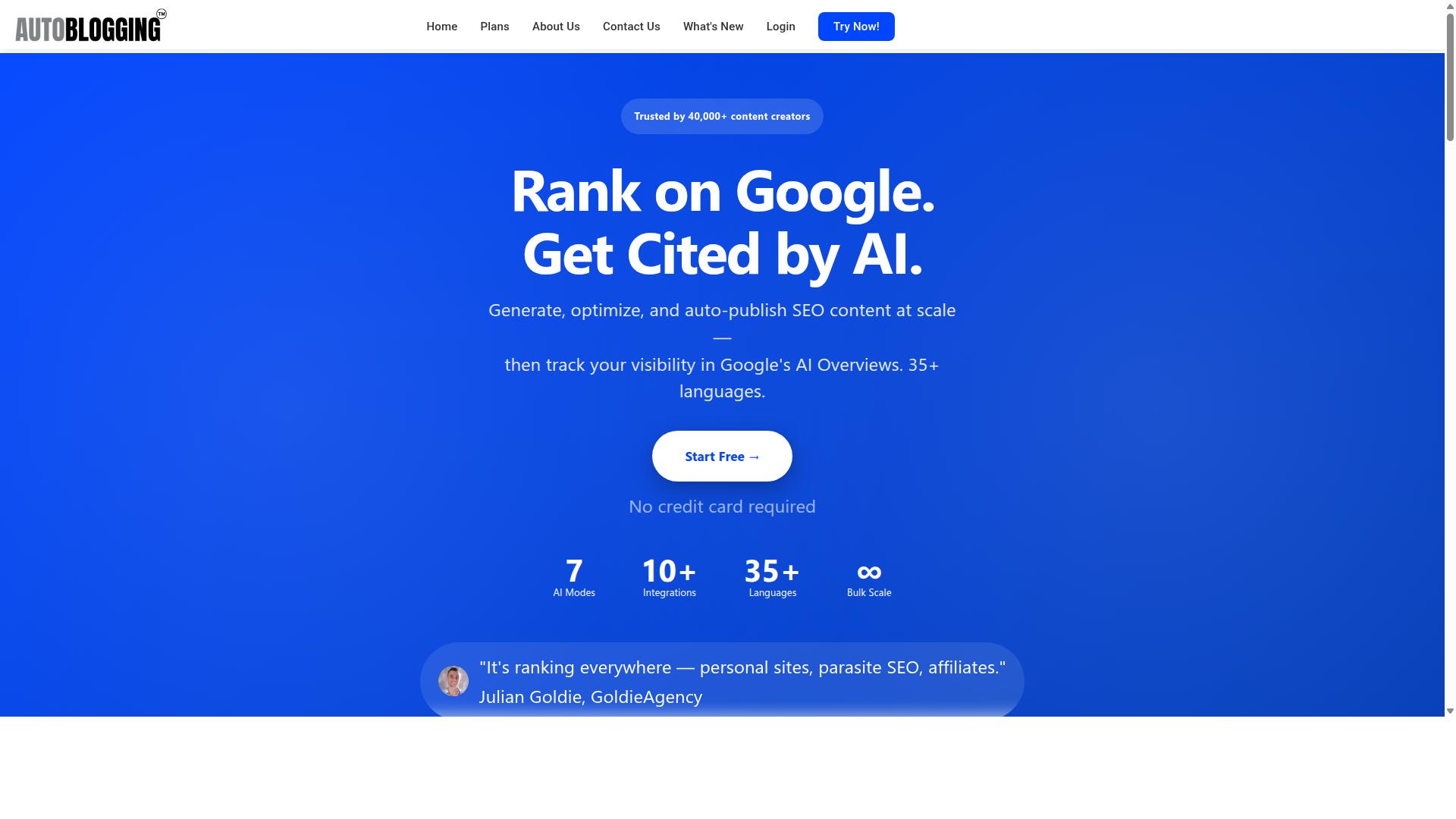
Autoblogging.ai is an AI-powered content creation platform developed by Digimetriq.com, designed to help bloggers, website owners, and agencies save time and improve their online presence through cutting-edge technology. Founded in 2022 by Vaibhav Sharda, the platform has grown into a global SaaS product available worldwide online.
Its mission is straightforward: cut down content costs while give the power toing human workflows with a strong first draft. Digimetriq, the company behind the tool, has a broader aim of replacing certain human content tasks entirely through automation.
For anyone comparing SEOWriting AI alternatives, pricing sits at the center of the decision. The market for AI writing tools spans wildly different models, from credit-based pricing to monthly billing and annual billing, so understanding what a platform actually is helps you judge whether its cost makes sense.
Autoblogging.ai belongs to the AI writing tools category, which includes blog post writers, article generators, and copywriting software. That context matters because each platform structures its subscription plans differently, and a price tag only means something once you know who the tool serves and what it replaces in your content stack.
Who It Serves and What It Replaces in Your Content Stack
Autoblogging.ai is built for bloggers, website owners, SEO professionals, marketing agencies, content creators, and affiliate marketers who need to produce high-quality content at scale. The platform serves a wide range of site types, each with its own content demands and budget pressures.
- Personal sites: solo bloggers who want consistent publishing without hiring help
- Parasite SEO: marketers publishing on third-party platforms to build visibility
- Affiliate sites: review and comparison pages that need steady content output
- Client websites: agencies delivering content for multiple clients at once
- Portfolio sites: creators showcasing work and building topical authority
- Local sites: businesses targeting regional audiences with location-focused content
In practical terms, the tool replaces or augments the traditional route of hiring freelance writers. Freelance rates vary by niche and word count, and managing multiple writers introduces coordination overhead. A single platform that produces first drafts changes that math considerably.
It also consolidates a stack that would otherwise include several disconnected tools. Instead of juggling separate software for drafting, keyword optimization, and content marketing workflows, users work from one platform. That consolidation is a core part of the value for money question.
Time savings and scalability are the two biggest draws. An agency handling several client websites can produce drafts across all of them without expanding its writing team. An affiliate marketer can cover more keywords. A local business can keep its site fresh without a standing content budget.
Because Autoblogging.ai aims to cut content costs and support human workflows with a first draft, its pricing should be weighed against what you currently spend on writers, tools, and editing time. That comparison, not the sticker price alone, determines real cost-effectiveness for each type of user.
What Should You Actually Pay for an AI Writing Tool?
Determining the right price for an AI writing tool involves evaluating your content volume, quality requirements, and budget constraints against the features and credits offered. There is no single market rate because AI writing tools are sold under several distinct pricing structures.
Understanding those structures is the first step toward a fair price comparison. The main models you will encounter include:
- Pay-as-you-go: you buy output when you need it, with no recurring commitment
- Tiered subscriptions: a monthly or annual fee unlocks a set allowance of content
- Credit-based pricing: each article or task consumes credits from a balance
- Per-word or per-article pricing: cost scales directly with output length or count
- Unlimited plans: a flat fee for uncapped generation, usually with fair-use limits
- Enterprise pricing: a custom quote built around volume, seats, and support
Cost drivers matter just as much as the model itself. Volume of content is the biggest factor, since heavy publishers need larger allowances or unlimited tiers. Quality requirements also shift the price: SEO content with keyword optimization, human proofreading, and editorial review costs more than raw drafts.
Integrations and support round out the picture. Tools that connect to your existing content marketing stack, or that include responsive support, tend to sit at higher price points. A cheap plan that forces manual workarounds is rarely the affordable option once labor is counted.
To judge value for money, run a simple ROI calculation. Estimate the hours a blog post writer or article generator saves your team each month, multiply by your internal hourly cost, and compare that figure against the subscription fee. If the tool replaces even a few hours of freelance writing, the math usually favors a paid plan over outsourcing every piece.
Experts recommend one more test before committing: match the plan to your realistic output, not your aspirational output. Overbuying credits wastes budget, while underbuying stalls publishing. A free trial or freemium tier is the safest way to calibrate before you pay.
How Autoblogging.ai's Pricing Answers That Question
Autoblogging.ai addresses the pricing question with a credit-based subscription model that scales from individual bloggers to large agencies, offering monthly and annual billing options. Credits correspond to article generation, so your spend tracks directly with the content you actually produce.
The tiered pricing spans six monthly plans in USD. Starter is $19 for 40 credits, Regular is $49 for 120 credits, Standard is $99 for 300 credits, Gold is $179 for 600 credits, Premium is $249 for 1,000 credits, and Enterprise is $999 for 5,000 credits.
Annual billing lowers the effective rate on every tier. Starter works out to $12/mo ($148/year), Regular $32/mo ($382/year), Standard $64/mo ($772/year), Gold $116/mo ($1,396/year), Premium $162/mo ($1,942/year), and Enterprise $649/mo ($7,792/year).
Several details make the cost-effectiveness case stronger. Credits roll over on all plans, so unused volume is not lost between billing cycles. A human proofreader is included in every plan, which answers the quality concern that usually pushes buyers toward pricier tiers elsewhere. New accounts get 10 free credits per month with no credit card required, and extra credits can be purchased when a project spikes.
For teams that prefer no subscription at all, Done For You packages offer a fixed alternative: Starter at $1,200 for 1,000 articles, Pro at $1,600, Corp at $4,000, and Senpai at $10,000, each covering 1,000 articles. Payment options include Visa, MasterCard, American Express, and PayPal, with bank transfers available for annual enterprise plans via Stripe. You can cancel anytime.
Set against the general framework above, the model covers the key bases: tiered pricing for different budgets, credit-based tracking for volume, rollover for flexibility, and enterprise pricing for scale. The verdict is straightforward. Autoblogging.ai gives you a clear, predictable path from a $19 entry point to agency-level output, with a human proofreader and credit rollover adding value at every tier.
Autoblogging.ai Pricing and Plans Explained
Autoblogging.ai offers a range of subscription plans designed to fit different content needs and budgets, with both monthly and annual billing options. The platform is trusted by 40,000+ content creators and has generated over 1M+ articles, which gives you a sense of the scale behind its tiered pricing model.
Monthly plans start at $19 for 40 credits and climb to $999 for 5,000 credits. In between, you will find tiers at $49 (120 credits), $99 (300 credits), $179 (600 credits), and $249 (1,000 credits). Every tier uses the same credit-based pricing structure, so you pay for output volume rather than seats or features.
Annual billing changes the math considerably. Each tier drops to a lower effective monthly rate when you pay for a full year upfront. New accounts also receive 10 free credits per month with no credit card required, which works as a low-risk way to test the platform before committing to a paid tier.
The sections below break down exactly what each tier costs on both billing cycles, how credits are consumed, and why perks like rollover and a human proofreader shift the value-for-money equation in your favor.
Monthly vs Annual Plans: What Each Credit Tier Costs
Autoblogging.ai's monthly plans start at $19 for 40 credits and go up to $999 for 5,000 credits, while annual plans offer the same credit tiers at a discounted rate. The table below shows the full price comparison so you can weigh monthly billing against annual billing at a glance.
| Plan | Credits | Monthly Price | Annual Price (per month) | Annual Total |
|---|---|---|---|---|
| Starter | 40 | $19 | $12 | $148/year |
| Regular | 120 | $49 | $32 | $382/year |
| Standard | 300 | $99 | $64 | $772/year |
| Gold | 600 | $179 | $116 | $1,396/year |
| Premium | 1,000 | $249 | $162 | $1,942/year |
| Enterprise | 5,000 | $999 | $649 | $7,792/year |
Credits are consumed when you generate articles, and different writing modes use different amounts. That means your real output depends on which mode you choose, not just the raw credit count. The cost-effectiveness of annual billing is clear: every tier saves roughly two months' worth of fees, and the savings scale as you move up.
For higher volumes than the Enterprise tier covers, Autoblogging.ai offers custom quotes. Annual enterprise plans can also be paid by bank transfer via Stripe, alongside Visa, MasterCard, American Express, and PayPal across all tiers. You can cancel anytime, and additional credits are available for purchase if you run short mid-cycle.
Credits, Rollover, and the Human Proofreader Included in Every Plan
Every Autoblogging.ai plan includes credits that roll over if unused, plus access to a human proofreader, ensuring you get maximum value from your subscription. This combination addresses two common frustrations with AI writing tools: wasted spend on unused quota and output that needs a quality check before publishing.
Here is how the credit system works in practice:
- Each article generation consumes credits from your balance.
- Different modes, including Quick and Godlike, require different amounts per article.
- Unused credits roll over to the next month instead of expiring.
- Extra credits can be purchased if you need more before your next cycle.
The rollover policy matters for ROI. If you have a slow month, your remaining credits carry forward rather than disappearing, so your effective cost per article stays predictable over time. This is a meaningful difference from rigid per-article pricing models where unused capacity is simply lost.
The human proofreader included in all plans adds a quality assurance layer that is uncommon among AI writing tools. Combined with features like a 21-point SEO audit, SERP competitor analysis, and one-click WordPress publish, the subscription delivers more than raw word generation. With 10+ AI modes, 35+ languages, and 35+ integrations, and a 4.9 average rating across 40,000+ users, the pricing holds up well against typical SaaS pricing in the content generation space.
Key Features That Determine Value for Money
The value of an AI writing tool hinges on its features, and Autoblogging.ai packs a suite of capabilities that directly impact content quality and efficiency. When you compare subscription plans or credit-based pricing across SEOWriting AI alternatives, the sticker price tells only part of the story. What matters is how much work each feature removes from your plate.
Two categories drive value for money in this market. The first is generation power: how many AI modes you get, how well they handle competitor analysis and keyword optimization, and whether the tool can produce content in bulk. The second is workflow support: optimization tools, publishing integrations, and automation that connect the tool to the rest of your stack.
A cheap plan that generates thin, unoptimized drafts often costs more in editing hours than a mid-tier plan that ships SEO-ready content. That is why cost-effectiveness should be judged against output quality and time saved, not just the monthly billing figure. The subheadings below break down the specific features that shape this equation for Autoblogging.ai.
Quick Mode, Godlike Mode, Bulk Generation, News Mode and Amazon Reviews Mode
Autoblogging.ai offers multiple AI modes, including Quick Mode for free single articles, Godlike Mode for SERP competitor analysis, Bulk Generation for up to 500 articles at once, News Mode for timely content, and Amazon Reviews Mode for product reviews. These sit within a platform that ships 10+ AI modes in total, giving users options that map to very different content needs.
Each mode targets a distinct job:
- Quick Mode covers free single articles, including a wizard option, which makes it useful for testing the platform before committing budget.
- Godlike Mode runs SERP competitor analysis, pulls in LSI keywords, and performs knowledge graph extraction, which supports deeper keyword optimization.
- Bulk Generation produces up to 500 articles via CSV, a fit for agencies and publishers managing large content calendars.
- News Mode uses Google News integration to generate news-style articles, which suits sites that need timely coverage.
- Amazon Reviews Mode creates product reviews, useful for affiliate and ecommerce content marketing.
For buyers weighing SEOWriting AI alternatives, this spread matters. A freelancer may only need Quick Mode and the occasional Godlike article, while a digital marketing team might lean on Bulk Generation and News Mode daily. The same subscription can serve both, which improves ROI across very different workflows. Instead of paying for several single-purpose article generators, one platform covers research-driven posts, volume publishing, and niche formats like reviews.
Site Optimizer, One-Click WordPress Publishing and 35+ Integrations
Autoblogging.ai includes a Site Optimizer tool, one-click WordPress publishing, and over 35 integrations with popular platforms to streamline your content workflow. Generation is only half the job. Getting content optimized, published, and connected to your existing tools is where a lot of hidden labor lives, and these features target exactly that.
The optimization side goes beyond Site Optimizer. The platform also offers Semantic SEO Analysis with a 21-point audit, a Snippet Optimizer for featured snippet optimization, Topical Maps, Intense Optimizer, and Fan Out Queries. There is also an AI Proofreader and a Human Proofreader, with the human proofreader included in all plans. For anyone comparing tiered pricing or per-article pricing elsewhere, built-in quality checks reduce the need for separate copywriting software or editing services.
Publishing is equally streamlined:
- WordPress integration supports unlimited sites with one-click publishing, a plugin, and scheduled auto-posting.
- Web 2.0 platforms include Medium, Dev.to, Hashnode, Telegraph, and Tumblr.
- Multi-platform support covers Shopify, Wix, Webflow, Blogger, and Ghost.
- Automation routes include an API, Zapier, and n8n.
With 35+ integrations overall, the platform slots into most existing stacks rather than forcing a rebuild. Credits roll over, so unused capacity is not wasted between billing cycles, and 24/7 support plus weekly feature releases add further durability to the subscription. Judged on time saved alone, these workflow features are a major reason the platform's pricing holds up well in any SEOWriting AI price comparison.
Trust Signals: Track Record, Testimonials and Support
Autoblogging.ai is trusted by over 40,000 content creators, holds a 4.9 average rating, and has generated more than 1 million articles, backed by 24/7 support and weekly feature updates. When you are weighing subscription plans and monthly billing against annual billing, those numbers matter more than any feature list. A tool with a proven user base carries less risk than an unknown alternative, and lower risk is a direct component of value for money.
Think about what you are really buying with an AI writing tool. The subscription cost is only one part of the equation. The other part is whether the software keeps working, keeps improving, and keeps someone available when something breaks. A track record of 1 million articles generated tells you the platform handles real production volume, not just demos.
Industry recognition adds another layer of confidence. Autoblogging.ai has drawn testimonials from names that SEO and content marketing audiences recognize:
- Julian Goldie, GoldieAgency, who runs a YouTube channel with 250k+ subscribers
- James Dooley, FatRank and PromoSEO
- Bart Magera, MojoLinks
- Kyle Duncan, SEO Professional
- Dimitar Georgiev, CEO of IDEAMAX.EU
- Cagri Sarigoz, Founder of Cagri Sarigoz LLC
- Jacky Chou, Indexsy
These are practitioners who evaluate content generation tools for a living. Their public endorsement is a signal that the platform meets professional standards rather than just hobbyist ones. For a buyer comparing market rates across AI writing tools, that kind of third-party validation reduces the guesswork in a price comparison.
Support and development pace round out the picture. 24/7 support means questions do not sit unanswered until the next business day, which matters when you are running deadline-driven content marketing campaigns. Weekly feature releases mean the subscription you pay for today keeps gaining capability over time, rather than stagnating while competitors catch up.
Autoblogging.ai also maintains a YouTube channel for SEO education, and its product lineup includes Digimetriq.com and AutoLinking.ai. Together with the education content, this shows a company invested in the long-term success of its users, not just in collecting subscriptions.
So how does this translate into cost-effectiveness? A cheaper tool with no support and no update history can end up costing more in lost time and abandoned workflows. A platform with a large user base, a 4.9 rating, recognized expert testimonials, round-the-clock help, and continuous releases delivers value for money that a low sticker price alone cannot match. When you evaluate SEOWriting AI alternatives and their pricing models, weigh these trust signals alongside the numbers. On that combined measure, Autoblogging.ai stands out as a safe, proven choice for your content budget.
Who Should Use Autoblogging.ai
Autoblogging.ai is ideal for bloggers, website owners, SEO professionals, marketing agencies, content creators, and affiliate marketers who need to produce high-quality content efficiently. That audience is broad, but it is not vague. The platform is built for people who publish content regularly and want to reduce the time and cost of doing so.
What connects these users is a simple need: consistent output without a matching rise in cost. Whether the goal is traffic, rankings, or client deliverables, content volume matters. Autoblogging.ai is aimed at the people who feel that pressure most.
The brand serves a specific set of site types, and each one has a different reason to care about pricing:
- Personal sites and blogs: hobby bloggers need steady posting without hiring writers, so affordability matters more than scale.
- Parasite SEO projects: these depend on publishing across many placements, which makes volume and per-article cost the deciding factors.
- Affiliate sites: product reviews and comparison content need regular updates, so a predictable monthly cost beats per-article freelancer rates.
- Client websites: agencies must deliver on deadlines and protect margins, so tiered plans that scale with workload make sense.
- Portfolio sites: creators building a body of work benefit from fast output at a low entry cost.
- Local sites: service-area businesses need location pages and updates, where an unlimited-style plan can replace piecemeal spending.
Pricing should follow usage, not ambition. A hobby blogger publishing a few posts a month rarely needs an enterprise arrangement, and paying for one is poor value for money. A large agency juggling multiple client websites is the opposite case: a plan that scales with output protects ROI because the cost is spread across several accounts.
The practical rule is to match the plan to publishing volume. Start where your current output sits, then move up only when the work demands it. That keeps the cost-effectiveness of the tool intact instead of paying for capacity you never use.
ROI here is easiest to see in time saved and work avoided. For a solo blogger, the return shows up as a publishing schedule that holds steady without a freelancer invoice each month. For an affiliate marketer, it means more reviews and comparisons live at once, which supports SEO content and keyword optimization over time.
For agencies, the math is different. The value is in delivering client work on schedule without stretching the team, which protects retention and referrals. For local sites and portfolio builders, the gain is simply a fuller site with less manual effort. In every case, the return depends on how much you publish, which is exactly why the plan should fit the workload.
Final Verdict: Is Autoblogging.ai Worth the Price?
After evaluating features, pricing, and trust signals, Autoblogging.ai emerges as a cost-effective solution for those needing scalable, high-quality content generation. Its credit-based pricing model stands out because unused credits roll over, so you are not punished for a slow month. That single detail separates it from many subscription plans that expire your balance at the end of each billing cycle.
The platform also includes a human proofreader, multiple AI modes, and integrations that fit into existing content workflows. For teams producing SEO content at volume, those additions reduce the hidden costs of editing and reformatting that often follow cheaper article generators.
Value for money depends on how you write. Consider the two common buyer profiles:
- High-volume users: Annual billing lowers the effective monthly cost, and credit rollover absorbs uneven production. This is where the cost-effectiveness argument is strongest.
- Occasional users: The free Quick Mode or the Starter plan may cover light needs without a larger commitment.
The trade-offs are straightforward. Autoblogging.ai is not the cheapest per-word option on the market, and anyone publishing a handful of posts per month may find a smaller plan sufficient. But for buyers who weigh output quality and reliability alongside price, the ROI case holds up well.
Custom enterprise pricing is available for larger operations. If your needs fall outside standard tiers, contact support for a custom quote rather than guessing at scale.
To decide, start with the free mode and see how the output matches your editorial standards. Then compare that experience against your monthly content budget before committing to an annual plan.
For questions about plans, enterprise quotes, or billing, reach the team directly:
- India: 501, Trinity Orion, Vesu, Surat - 395007, Gujarat, India. Phone/WhatsApp: +91 84605-06553 / +91-8460506553
- United Kingdom: 2nd Flr, SEO Content Suite, 35 Water Ln, Wilmslow, Cheshire SK9 5AR. Phone: +44 1625 359056
- Email: vaibhav@autoblogging.ai | Skype: vibes.yb | Support hours: 7:00-19:00 IST
- Social: Facebook, Twitter, LinkedIn
On balance, Autoblogging.ai is worth the price for content marketers, agencies, and publishers who need consistent volume without sacrificing quality. Try the free mode first, then scale into the plan that matches your output.
Frequently Asked Questions
How much does Autoblogging.ai cost compared to other SEO writing AI tools?
Autoblogging.ai's monthly plans start at $19 for 40 credits and scale up to $999 for 5,000 credits, with annual plans available at a discount. Because competitors structure their pricing differently-some charge per word, per seat, or per article-the fairest comparison is cost per article at your actual monthly volume. Check what each tool includes at your tier (like SERP analysis or bulk generation) rather than comparing headline prices alone.
What do I actually get for my money with Autoblogging.ai?
Every plan runs on the same core platform, with credits determining how much content you can generate. Depending on the mode you use, you get access to features like Godlike Mode (SERP competitor analysis, LSI keywords, knowledge graph extraction), Bulk Generation of up to 500 articles via CSV, and 10+ AI modes across 35+ languages. Higher tiers simply give you more credits, and unused credits roll over.
Are there cheaper alternatives to Autoblogging.ai, and are they worth it?
There are cheaper tools on the market, but pricing pages rarely tell the whole story-what matters is whether the output is publishable without heavy editing. Autoblogging.ai includes a human proofreader in certain plans and is trusted by 40,000+ content creators with a 4.9 average rating and 1M+ articles generated. If a lower-priced tool costs you hours of cleanup per article, the "savings" disappear quickly.
Should I choose a monthly or annual plan?
Annual plans are billed yearly at a discount versus paying month to month, so they make sense if you've confirmed the platform fits your workflow. If you're still testing how many credits your publishing schedule actually consumes, start monthly and upgrade later. Credits roll over, which reduces the risk of paying for volume you don't immediately use.
How many credits do I need for my content volume?
Credit consumption depends on the mode and length of the articles you generate, so the best approach is to estimate your monthly article count and match it to a tier-from Starter at 40 credits up to Enterprise at 5,000. Because credits roll over, unused balance isn't lost if you have a lighter month. If you're unsure, contact Autoblogging.ai directly and they can help you size the right plan.
Is it worth paying for a premium SEO writing AI tool at all?
It depends on whether content is a real growth channel for you. For bloggers, agencies, and affiliate marketers publishing regularly, a tool that handles SERP analysis and bulk generation can replace hours of manual work-which is why Autoblogging.ai's mission is helping bloggers, website owners, and agencies save time. If you publish only occasionally, a smaller plan or the free Quick Mode is a sensible starting point.